40
Ai Operating Models
Ai Operating Models
Ai Operating Models
Hybrid
Editorial and technical dispatches
Ai Operating ModelsDecision Architecture
3 Things AI: The "Controls Need Receipts" Edition
Three current AI signals translated into practical operating consequences for SMEs, Canadian business leaders, and AI-native operators.
Jul 20, 2026
Read brief
Ai Operating ModelsDecision Architecture
3 Things AI: The "Proof Before Rollout" Edition
Three current AI signals translated into practical operating consequences for SMEs, Canadian business leaders, and AI-native operators.
Jul 19, 2026
Read brief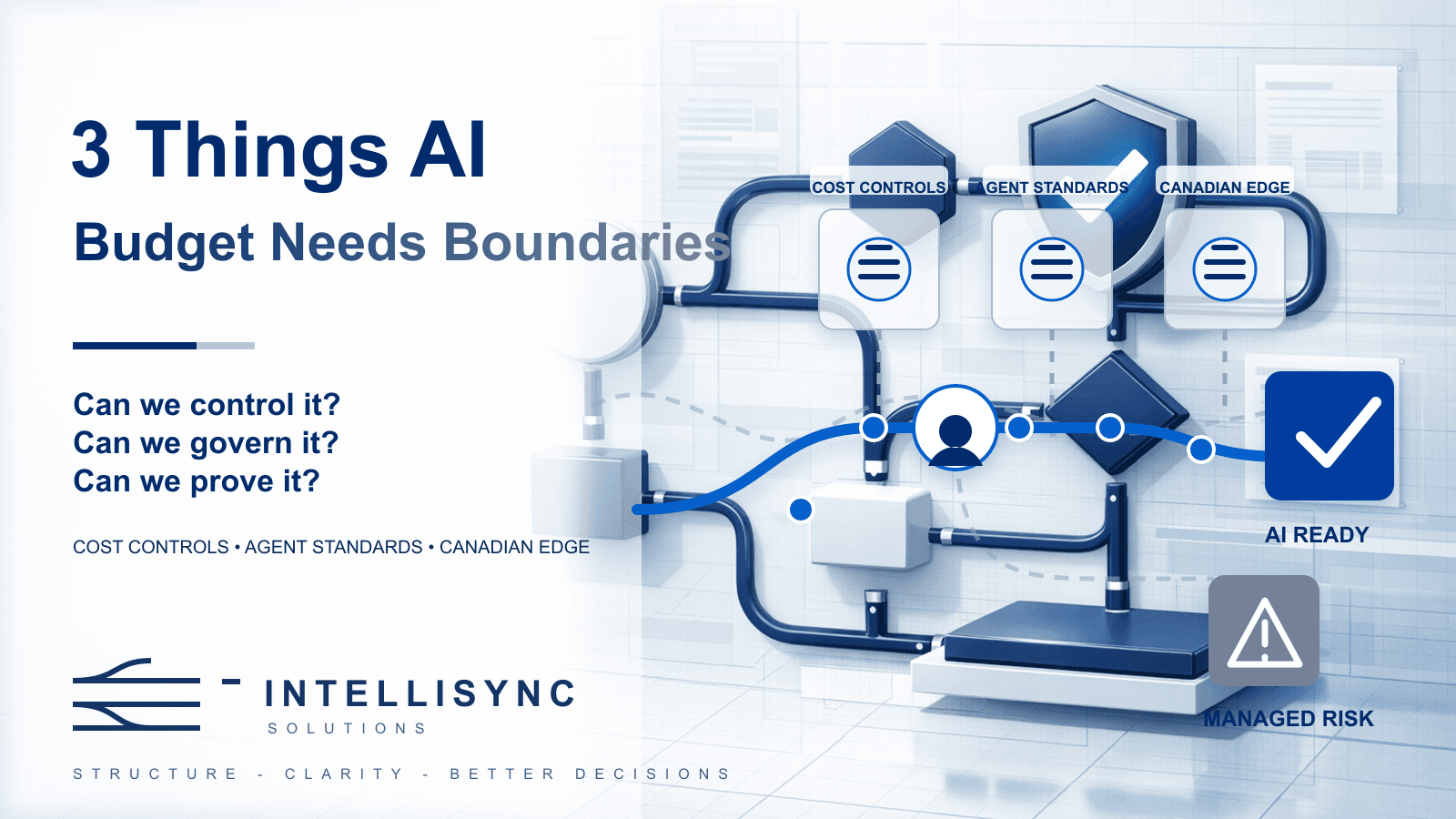
Ai Operating ModelsDecision Architecture
3 Things AI: The "Budget Needs Boundaries" Edition
Three current AI signals translated into practical operating consequences for SMEs, Canadian business leaders, and AI-native operators.
Jul 18, 2026
Read brief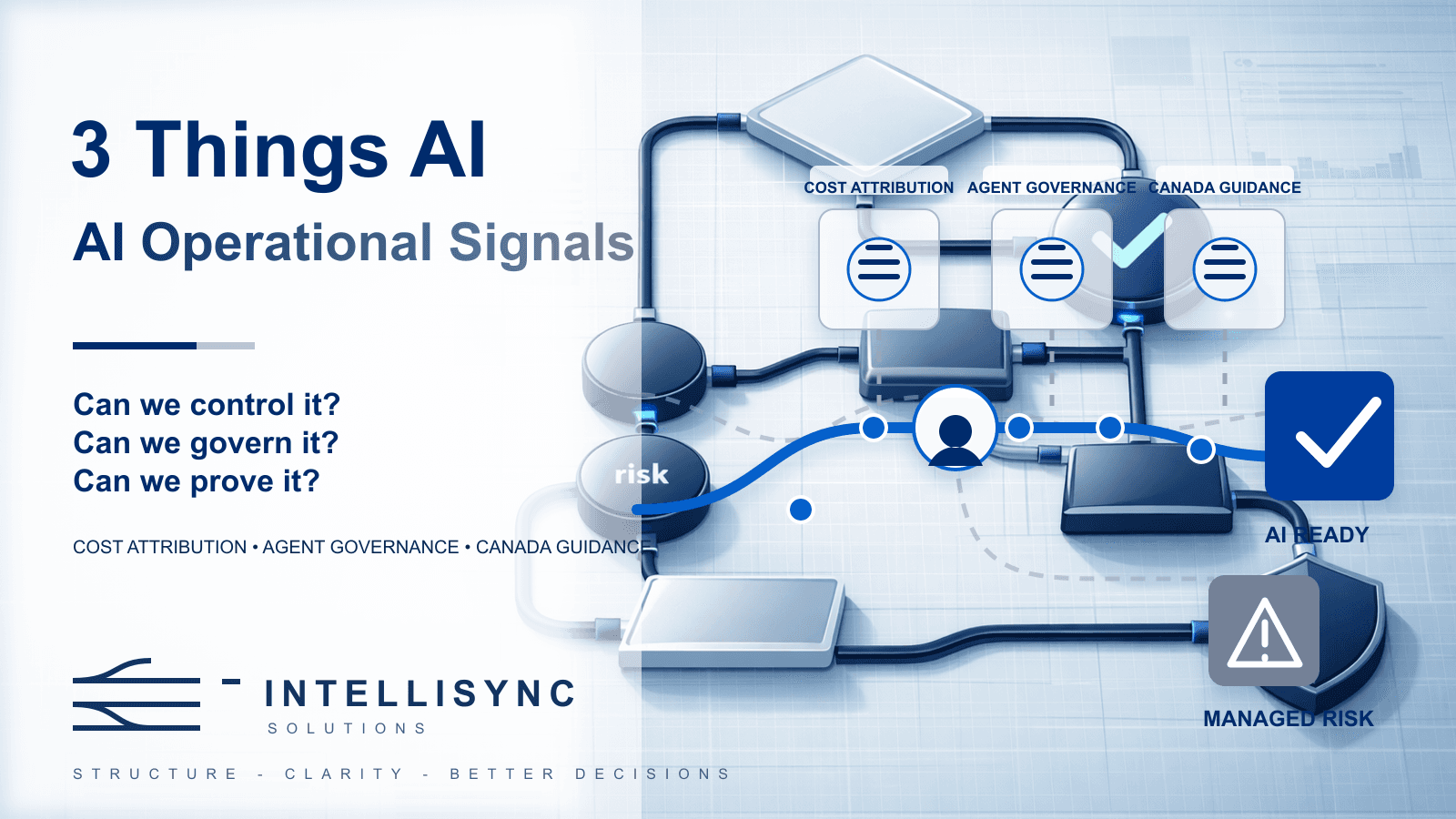
Ai Operating ModelsDecision Architecture
3 Things AI: The "AI Operational Signals" Edition
Three current AI signals translated into practical operating consequences for SMEs, Canadian business leaders, and AI-native operators.
Jul 17, 2026
Read brief
Ai Operating ModelsDecision Architecture
3 Things AI: The "Useful AI Needs Controls" Edition
Three current AI signals translated into practical operating consequences for SMEs, Canadian business leaders, and AI-native operators.
Jul 16, 2026
Read brief
Ai Operating ModelsDecision Architecture
3 Things AI: The "Daily AI Brief" Edition
Three current AI signals translated into practical operating consequences for SMEs, Canadian business leaders, and AI-native operators.
Jul 15, 2026
Read brief
Ai Operating ModelsDecision Architecture
3 Things AI: The "Your AI Budget Needs a Seatbelt" Edition
Three current AI signals translated into practical operating consequences for SMEs, Canadian business leaders, and AI-native operators.
Jul 14, 2026
Read brief
Ai Operating ModelsDecision Architecture
3 Things AI: The "Signals Need Systems" Edition
Three current AI signals translated into practical operating consequences for SMEs, Canadian business leaders, and AI-native operators.
Jul 13, 2026
Read brief
Ai Operating ModelsDecision Architecture
3 Things AI: The "Govern the Knowledge Layer" Edition
Three current AI signals translated into practical operating consequences for SMEs, Canadian business leaders, and AI-native operators.
Jul 12, 2026
Read brief
Ai Operating ModelsDecision Architecture
3 Things AI: The "Search Needs Proof" Edition
Three current AI signals translated into practical operating consequences for SMEs, Canadian business leaders, and AI-native operators.
Jul 11, 2026
Read brief
Ai Operating ModelsDecision Architecture
3 Things AI: The "Maturity Beats Motion" Edition
Three current AI signals translated into practical operating consequences for SMEs, Canadian business leaders, and AI-native operators.
Jul 10, 2026
Read briefAi Operating ModelsDecision Architecture
3 Things AI: The "Your AI Strategy Needs Receipts" Edition
Three current AI signals translated into practical operating consequences for SMEs, Canadian business leaders, and AI-native operators.
Jul 9, 2026
Read brief
Ai Operating ModelsDecision Architecture
Token Billing in the Agentic AI Era: Why AI Spend Is Becoming Workflow Architecture
A decision-architecture guide for Canadian SMBs managing AI spend as token billing expands into reasoning, tools, retrieval, caching, storage, runtime, and agentic workflow meters.
Jun 16, 2026
Read briefHuman Centered ArchitectureAi Operating Models
Operational intelligence mapping: route reviews and prove ownership before AI decisions scale
A practical decision-architecture checklist for Canadian teams using AI in operations: detect context breaks, route review thresholds, and attach auditable ownership to outcomes—before you scale.
Jun 10, 2026
Read briefDecision ArchitectureAi Operating Models
Context Failures Aren’t a Model Problem: Escalate with Proof Using Decision Architecture
A decision-architecture playbook for Canadian executives and operators to handle context failures in AI-supported workflows: define the signal, interpret with logic, assign an accountable owner, and escalate with auditable primary-source proof.
Jun 8, 2026
Read briefHuman Centered ArchitectureAi Operating Models
Signal Triage for Agent Orchestration: Make AI Decisions Auditable Before You Scale Them
A governance-ready operating cadence for Canadian SMBs: how to triage agent signals into reviewable decisions with context integrity, traceability, and owned outcomes.
May 31, 2026
Read briefOrganizational CultureAi Operating Models
Exception handling that won’t break cadence: review thresholds, escalation ownership, organizational memory
A practical decision architecture for Canadian SMBs: set review thresholds, assign escalation ownership, and capture exceptions as organizational memory so agent ops can keep cadence without becoming an audit risk.
May 26, 2026
Read briefHuman Centered ArchitectureAi Operating Models
Prevent signal misreads and exception loss in agent handoffs with decision architecture
A decision-architecture memo for Canadian execs and cross-functional operators: how to stop context systems from misreading signals, losing exceptions, and breaking ownership during agent handoffs—so decisions stay auditable and operationally reusable.
May 21, 2026
Read briefOrganizational Intelligence DesignAi Operating Models
Audit-ready decision ownership for agent workflows
A practical decision-architecture blueprint for Canadian executives: review thresholds, escalation paths, and outcome trace so agent work stays auditable, source-grounded, and reusable.
May 20, 2026
Read briefOrganizational Intelligence DesignAi Operating Models
Prevent exception rewrites at agent handoffs by treating context as a decision capsule
When AI agents switch hands, teams often “patch the story” instead of auditing the decision. This article shows how AI-native operating architecture for context systems makes every handoff decision auditable, grounded in primary sources, and reusable in Canadian SMB operations.
May 19, 2026
Read briefDecision ArchitectureAi Operating Models
Fix decision–outcome ownership gaps with Context Integrity Audits in Canadian SMB AI
A practical, Canadian SMB guide to running Context Integrity Audits that detect decision-outcome ownership gaps—so AI-supported decisions stay auditable, grounded in primary sources, and operationally reusable.
May 16, 2026
Read briefAi Operating Models
Stop treating prompts as governance: AI-native belongs on your exception boundary
A decision memo for women owner-operators and consultants in Canada: when “AI-native” is the right operating architecture choice for exception-heavy client work—and when it’s a risky shortcut.
May 12, 2026
Read briefOrganizational Intelligence DesignAi Operating Models
Owned exception routing: how to go from “AI flagged it” to audit-ready decisions
A decision-architecture guide for Canadian executives and operations leaders on mapping exceptions you own—from first signal detection through governance-ready orchestration that stays auditable with primary-source evidence.
May 12, 2026
Read briefAi Operating ModelsOrganizational Intelligence Design
Agent escalations that auditors can replay: traceability, owner routing, and review thresholds
Executive and technical decision-makers need agent escalations that are auditable and operationally reusable. This editorial explains a decision architecture for context integrity: traceability, exception ownership, and review thresholds that don’t drift—grounded in primary sources for Canadian AI governance.
May 11, 2026
Read briefOrganizational Intelligence DesignAi Operating Models
Approval Gaps in AI Workflows: Fix Context Drift with Signal-to-Action Governance
A practical decision-architecture memo for Canadian executives and operations leaders: how to prevent context drift and approval gaps by grounding AI-supported decisions in traceable signals, primary sources, and reusable review logic.
May 10, 2026
Read briefAi Operating ModelsTeam Dynamics
AI implementation is breaking in SMBs because nobody owns the decision
For Canadian owner-operators and small leadership teams: why AI implementations stall, how “AI should structure thinking” changes the build, and the operating thresholds that decide whether a focused tool is enough or private AI workflow software is required.
May 3, 2026
Read briefAgent SystemsAi Operating Models
Exception handling is the escalation contract for AI agents in SMB operations
Operations teams in Canadian SMBs can’t safely scale AI-enabled workflows without an exception-handling architecture that assigns escalation ownership and turns operational signals into decision-ready review.
Apr 28, 2026
Read briefAi Operating ModelsCanadian Ai Governance
Mythbusting AI Use in Business: Where Adoption Ends and Governance Begins
AI use is widespread, but much of it is shallow, unsanctioned, or detached from governed operating architecture. Leaders should stop asking whether AI is being used and start asking where, by whom, on what data, and under which controls.
Apr 24, 2026
Read briefAi Operating Models
Governance-Ready AI-Native Operating Architecture for Operational Cadence
Decision architecture, context systems, and agent orchestration can make AI decisions auditable, grounded in primary sources, and reusable—without breaking operational speed. Written by Chris June (IntelliSync).
Apr 23, 2026
Read briefAi Operating ModelsDecision Architecture
Gouvernance-Ready AI-Native Operating Architecture
How context systems and agent orchestration create decision architecture that is auditable, grounded in primary sources, and reusable—at scale—using Canadian governance expectations as the design constraint.
Apr 22, 2026
Read briefAi Operating Models
Governance-Ready AI-Native Operating Architecture: Decision & Context Systems for Reliable Agent Orchestration
A decision architecture approach to make AI-native agent orchestration auditable: grounded in primary sources, designed for operational reuse, and mapped to context systems and a governance layer.
Apr 21, 2026
Read briefAi Operating ModelsOrganizational Intelligence Design
Architecture-First AI Governance for Operational Intelligence
Decision architecture, context systems, and orchestration form an auditable AI operating architecture—so governance becomes operational reuse, not a slide deck.
Apr 17, 2026
Read briefAi Operating ModelsDecision Architecture
Operational Intelligence Mapping for AI-Native Operating Architecture: Governance-Ready Context Flows & Agent Orchestration
An architecture-first guide for Canadian executives and technology/operations leaders to design decision architecture, context systems, and agent orchestration that are auditable, grounded in primary sources, and reusable in operations.
Apr 16, 2026
Read briefAi Operating Models
Governance-Ready AI-Native Operating Architecture for Canada
A decision-architecture blueprint for context integrity, orchestration clarity, and auditable operating cadence—grounded in Canadian first-party governance requirements.
Apr 16, 2026
Read briefAi Operating ModelsDecision Architecture
Designing an AI-Native Operating Architecture for Auditable Decisions
A governance-ready approach to decision architecture: how to preserve context integrity, orchestrate review, and make AI-supported decisions auditable using grounded primary-source controls—built for operational reuse in Canada.
Apr 14, 2026
Read briefAi Operating ModelsOrganizational Intelligence Design
AI-Native Decision & Context Architecture for Agent Orchestration
Decision architecture for agent orchestration should be auditable, grounded in primary sources, and reusable operational intelligence—so governance is implemented in the workflow, not after the fact.
Apr 13, 2026
Read briefAi Operating ModelsOrganizational Intelligence Design
AI-Native Operating Architecture for Decision Quality
Décisions auditées, contexte traçable, orchestration d’agents et mémoire organisationnelle gouvernable — un modèle d’architecture « AI-native » pour améliorer la qualité et l’exécutabilité des décisions dans les organisations canadiennes.
Apr 10, 2026
Read briefDecision ArchitectureAi Operating Models
IntelliSync: If everyone can access AI, who owns the advantage?
AI access is now broadly available, but advantage is still architectural. SMBs win by redesigning decision architecture and embedding operational intelligence into core workflows.
Apr 9, 2026
Read briefDecision ArchitectureAi Operating Models
IntelliSync Editorial: Law Firm AI Risk Reduction Through Checkpoints (Not Automation Sprawl)
A small Canadian law practice can reduce administrative burden with AI only if it treats automation like a workflow design problem: intake, status tracking, drafting support, and internal updates are structured around explicit review checkpoints.
Apr 7, 2026
Read briefAi Operating ModelsDecision Architecture
AI operating architecture: the production layer for context, orchestration, memory, controls, and review
AI operating architecture is the production layer that keeps AI useful by structuring context, orchestration, memory, controls, and human review around the work. For Canadian decision-makers, it turns one-off pilots into scalable, auditable operations.
Apr 7, 2026
Read brief