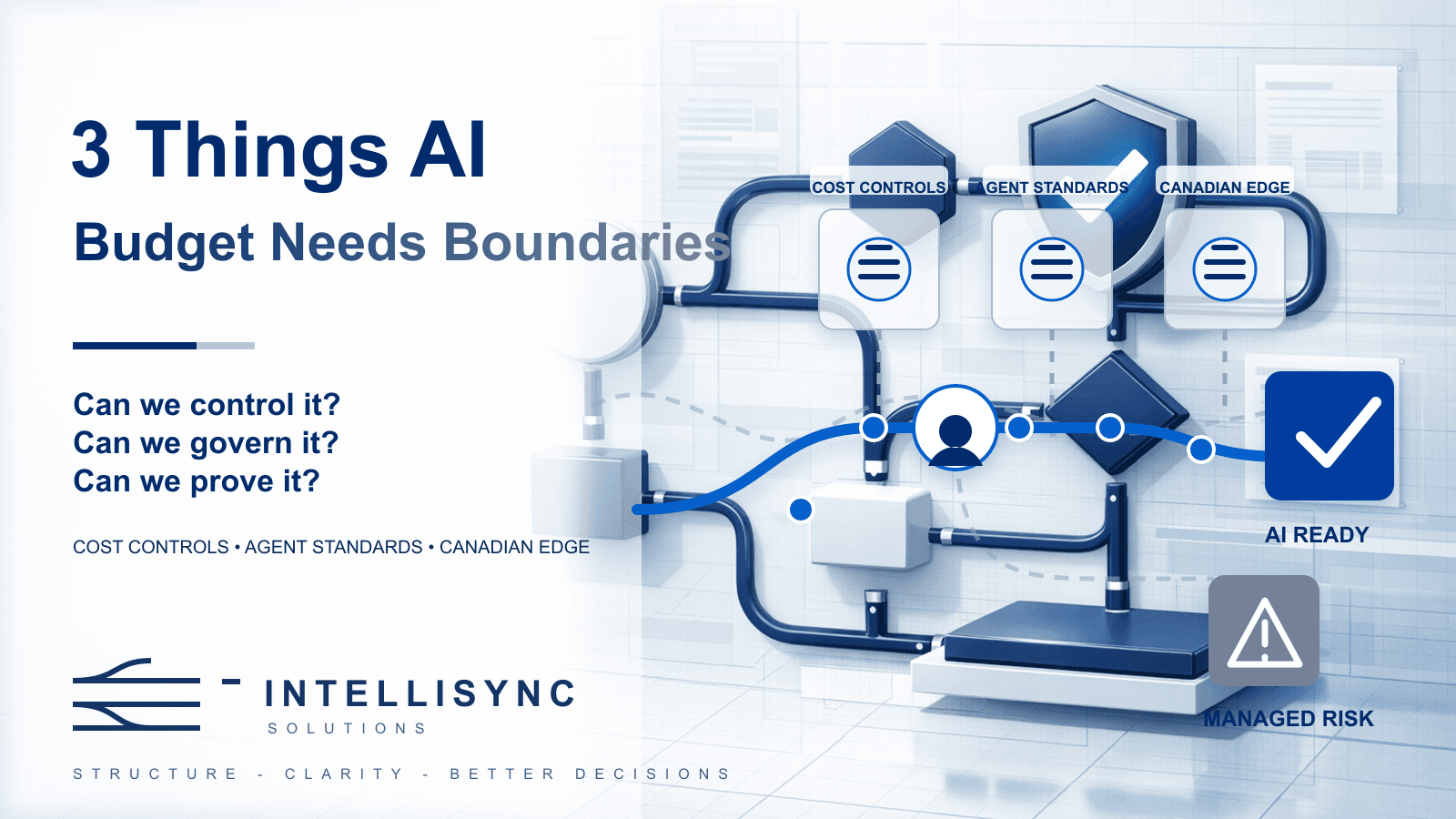
The work is not to produce more output. It is to structure the thinking around the decision, the context, the signal, the review logic, and the owner who keeps the workflow accountable.
Finance teams don’t get stuck because their AI can’t write a report. They get stuck because decisions stall: evidence is inconsistent, logic is undocumented, and “human review” becomes a throughput choke point.Decision architecture is the operating system that determines how context flows, decisions are made, approvals are triggered, and outcomes are owned inside a business. (airc.nist.gov)For Canadian SMB finance leaders (and controllers/fractional CFOs serving them), the fix is not better prompts. It’s AI operating architecture that treats decision quality—signal quality, judgment ownership, escalation thresholds—as a production constraint.
Where decisions stall inside finance AI workflows
Finance teams typically adopt
AI to speed up summarization, variance narratives, or “what should we do next?” drafts. But in production, the bottleneck is earlier: translating messy inputs into a decision that an accountable owner can execute. A recurring pattern from human-in-the-loop research is that inserting humans without structuring the task can change incentives and reduce accuracy or slow decisions. In one study, “putting a human in loop” did not automatically improve the final decision quality, and the system-level effect could reduce accuracy even if uptake increased. (journals.plos.org)
In a Canadian SMB finance context, the stall usually looks like this:Signal or input -> interpretation logic -> decision or review -> business outcome1) Signal: irregular bank feeds, missing invoice metadata, or policy exceptions hidden in unstructured notes.2) Logic: ad-hoc interpretation (“assume it’s recurring,” “ignore one-off taxes,” “use last month”) without a written decision rule.3) Decision or review: controller “checks” by reading long explanations instead of verifying a small set of decision-relevant facts.4) Outcome: late closures, rework in month-end, and delayed cash decisions.> [!INSIGHT] In finance AI workflows, the most expensive delay is not model inference—it’s the time it takes a decision-maker to rediscover what “counts” as evidence.The proof you can use internally: audit your last 10 AI-assisted decisions and label each as (a) clear decision rule applied, (b) evidence disputed, (c) logic unclear, or (d) no escalation path. If most fall into (b)-(d), your architecture is the issue—not the tool.
Connect evidence quality to escalation
rules
If decision quality is your objective, “evidence quality” must be operationalized into escalation. The NIST AI Risk Management Framework emphasizes governance across the AI lifecycle, including mapping roles and responsibilities for human-AI configurations and oversight. (airc.nist.gov)
That matters because escalation is where judgment stays accountable. OECD’s AI principles also call for safeguards for human agency/oversight and an accountability approach informed by roles and the ability to act. (oecd.org)Here’s the practical operating move for finance:Design a decision rule that gates human review based on evidence confidence—not on whether the AI produced fluent text.Example (monthly AR collectability flags for a private internal AI system):Decision: “Auto-approve collectability adjustment” vs “Escalate to controller.”Selection criteria (a simple threshold you can implement):
- Evidence completeness score >= 0.85 (all required fields present: customer terms, invoice aging, dispute status, payment history last 60 days).
- Reconciliation variance <= $250 for the decision period.
- No policy exception tags (e.g., settlements, credit notes, disputed invoices) present in source documents.
Escalation threshold:
- If completeness < 0.85 OR reconciliation variance > $250 OR exception tags present -> route to controller review with a structured checklist.
Why this works: it converts “human in the loop” from open-ended reading into targeted verification of a small number of decision-critical facts.Research supports the idea that interaction design and task structure change outcomes; human-AI collaboration can amplify bias or distort judgment when the interaction pattern is poorly designed. (nature.com)> [!WARNING] If you escalate every ambiguous case to the same person without thresholds, you’ll create a review backlog—and accuracy may not improve.
Use research evidence without outsourcing judgment
You don’t need to “trust
the model.” You need to use research evidence to define how you evaluate, not to replace the owner. The evidence base is clear about a hard truth: automated decision supports are not automatically safer just because a human is present. Human-algorithm interaction can produce system-level accuracy trade-offs and cognitive overload when reviewers cannot interpret or challenge the basis of recommendations. (journals.plos.org)
So, in Canadian finance operations, the right division of labor is:
- The AI system performs: retrieval, classification, normalization, and evidence packaging.
- The finance owner performs: decision logic validation, exception handling, and sign-off for consequence-heavy actions.
This aligns with governance being a control system for oversight, traceability, review thresholds, and escalation paths. (airc.nist.gov)In practice, adopt “evidence cards” generated by the AI but reviewed by the accountable owner:
- What data was used.
- What evidence was missing.
- Which rule path was taken.
- What the decision consequence is (posting, adjustment, cash action, or policy breach).
Then set a “consequence-based” review policy:
- Low consequence (draft-only, no posting): auto-resolve with logging.
- Medium consequence (posting adjustment above minor threshold): controller review required.
- High consequence (policy exception, fiduciary/legal impact, or large amount): escalation to a designated finance authority and documented rationale.
Canadian privacy context matters even inside private internal systems when AI touches personal information (e.g., customer correspondence). The Office of the Privacy Commissioner of Canada (OPC) stresses the need for meaningful consent and minimizing risk when organizations collect, use, or disclose personal information. (priv.gc.ca)So your operating architecture should also gate data use:
- Only attach personal identifiers to the minimum decision payload required.
- Keep source documents attached for traceability (so review is evidence-based, not narrative-based).
Design operating cadence around decision
consequence
The biggest failure mode isn’t missing AI features—it’s missing operating cadence. When decision review happens “whenever the output arrives,” you get throughput variance and repeated rework.
ISO-style risk management processes (communication, consultation, monitoring, and review) are a useful reminder that governance is ongoing, not a one-time rollout. (oecd.org)Translate this into a finance cadence like this:
- Daily: evidence packaging + completeness scoring for upcoming decisions.
- Weekly: controller review queue for medium-consequence cases with evidence cards.
- Monthly close: consequence-based sign-off with traceable decision logs.
One owner, one reviewer, one escalation path:
- Owner: controller or fractional CFO (depending on the SMB’s structure).
- Reviewer: designated finance lead for disputes or evidence disputes.
- Escalation: CFO/owner for high consequence exceptions.> [!DECISION] If your AI workflow produces faster drafts but not faster decisions, you haven’t fixed decision quality—you’ve only improved output speed.A concrete workflow redesign example (budget variance + reforecast, client-facing secure workflow boundary):
- Input: weekly cost feed + prior forecast + policy tags.
- Logic: compute variance bands and evidence completeness (e.g., “missing vendor category” vs “unexpected timing”).
- Decision: auto-prepare reforecast only when evidence completeness >= 0.85 and variance is inside expected band.
- Escalation: if variance is outside band OR evidence incomplete -> route to controller with a three-question checklist.
This change shifts time from “reading AI prose” to verifying decision-relevant evidence.
Make the next move: structure decisions
, then automate
For Canadian finance
teams, the fastest path to better AI outcomes is an architecture-first decision restructure:1) Pick one finance bottleneck decision with consequence (e.g., AR collectability adjustments, reforecast triggers, or month-end posting exceptions).2) Define the decision owner and the reviewer.3) Specify a rule path: evidence completeness + exception tags + reconciliation tolerance.4) Implement logging so you can measure which rule paths were taken and where stalls occurred.5) Only after the decision paths stabilize, automate the evidence packaging and draft outputs. If you do this correctly, you’ll see decision quality improve even when model accuracy is unchanged—because the bottleneck was structural.Authority line: “Output is cheap; structured thinking is the scarce operating asset.”
To structure the thinking in your organization, start with IntelliSync’s Architecture Assessment and then view the operating architecture approach.CTA: View Operating Architecture
What breaks when the thinking stays implicit
The main failure mode is treating fluent output as a reliable decision. Without a threshold, owner, and shared context, the system amplifies exceptions instead of making them visible.