41
Decision Architecture
Decision Architecture
Decision Architecture
Hybrid
Editorial and technical dispatches
Ai Operating ModelsDecision Architecture
3 Things AI: The "Controls Need Receipts" Edition
Three current AI signals translated into practical operating consequences for SMEs, Canadian business leaders, and AI-native operators.
Jul 20, 2026
Read brief
Ai Operating ModelsDecision Architecture
3 Things AI: The "Proof Before Rollout" Edition
Three current AI signals translated into practical operating consequences for SMEs, Canadian business leaders, and AI-native operators.
Jul 19, 2026
Read brief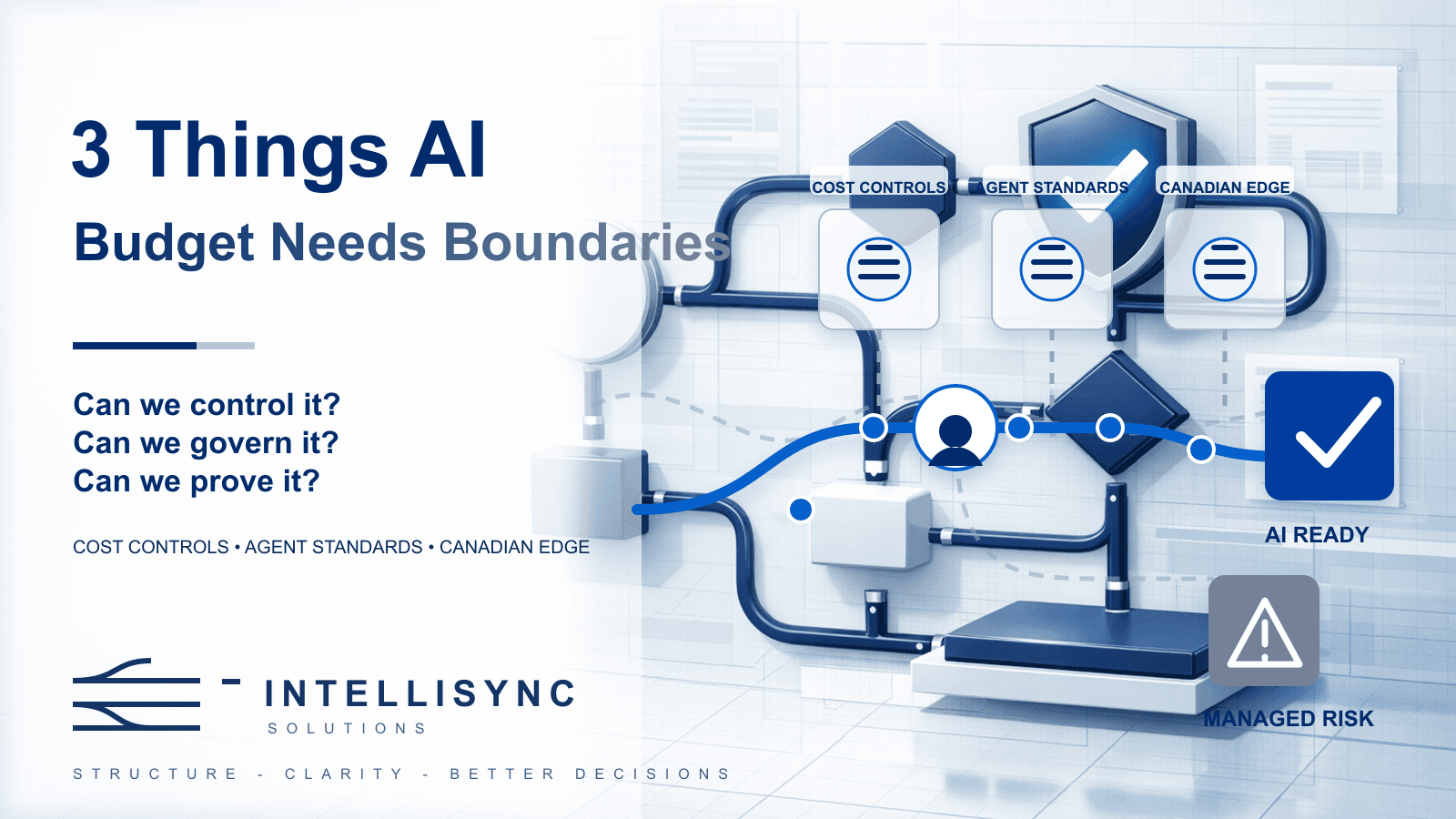
Ai Operating ModelsDecision Architecture
3 Things AI: The "Budget Needs Boundaries" Edition
Three current AI signals translated into practical operating consequences for SMEs, Canadian business leaders, and AI-native operators.
Jul 18, 2026
Read brief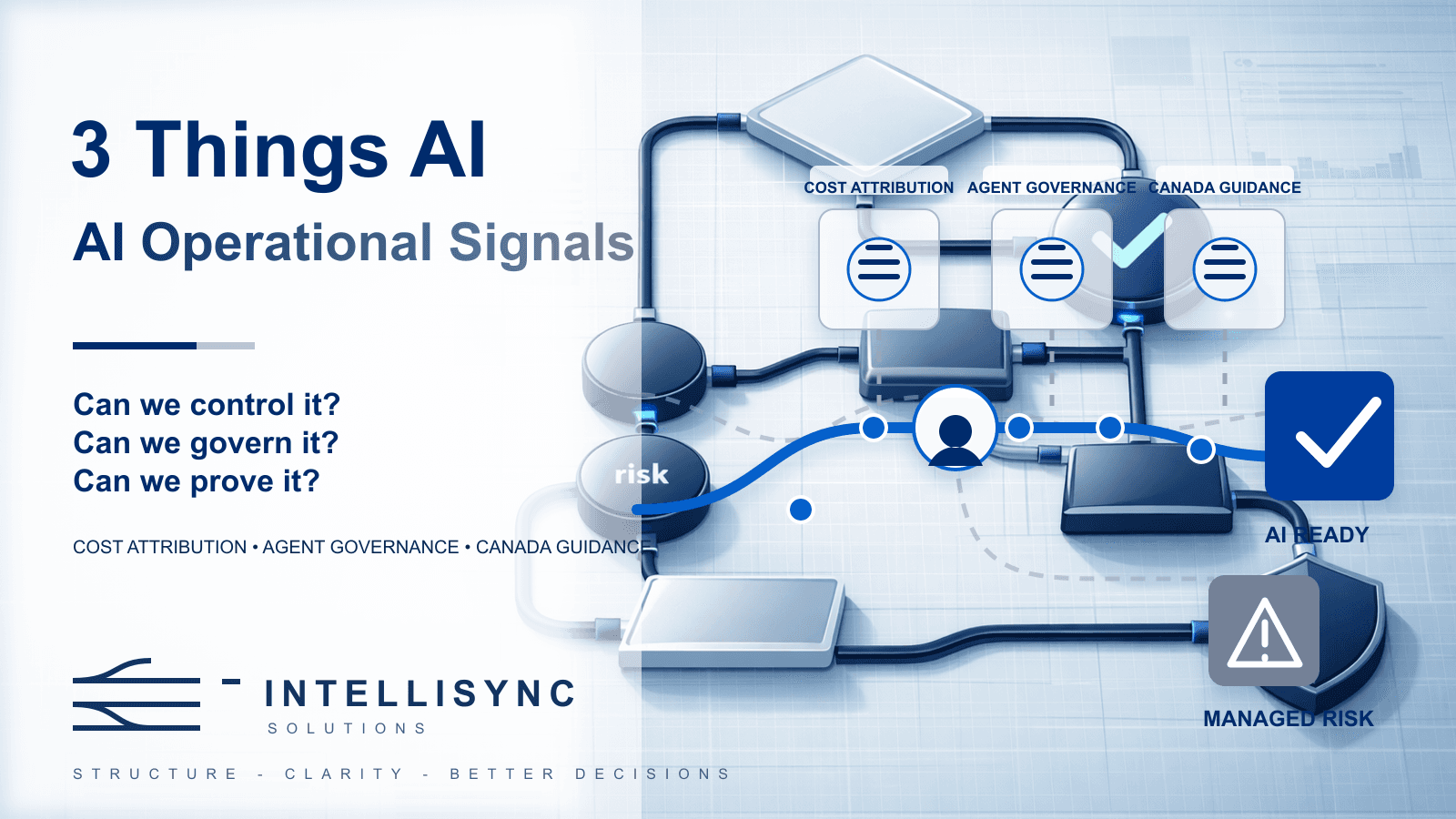
Ai Operating ModelsDecision Architecture
3 Things AI: The "AI Operational Signals" Edition
Three current AI signals translated into practical operating consequences for SMEs, Canadian business leaders, and AI-native operators.
Jul 17, 2026
Read brief
Ai Operating ModelsDecision Architecture
3 Things AI: The "Useful AI Needs Controls" Edition
Three current AI signals translated into practical operating consequences for SMEs, Canadian business leaders, and AI-native operators.
Jul 16, 2026
Read brief
Ai Operating ModelsDecision Architecture
3 Things AI: The "Daily AI Brief" Edition
Three current AI signals translated into practical operating consequences for SMEs, Canadian business leaders, and AI-native operators.
Jul 15, 2026
Read brief
Ai Operating ModelsDecision Architecture
3 Things AI: The "Your AI Budget Needs a Seatbelt" Edition
Three current AI signals translated into practical operating consequences for SMEs, Canadian business leaders, and AI-native operators.
Jul 14, 2026
Read brief
Ai Operating ModelsDecision Architecture
3 Things AI: The "Signals Need Systems" Edition
Three current AI signals translated into practical operating consequences for SMEs, Canadian business leaders, and AI-native operators.
Jul 13, 2026
Read brief
Ai Operating ModelsDecision Architecture
3 Things AI: The "Govern the Knowledge Layer" Edition
Three current AI signals translated into practical operating consequences for SMEs, Canadian business leaders, and AI-native operators.
Jul 12, 2026
Read brief
Ai Operating ModelsDecision Architecture
3 Things AI: The "Search Needs Proof" Edition
Three current AI signals translated into practical operating consequences for SMEs, Canadian business leaders, and AI-native operators.
Jul 11, 2026
Read brief
Ai Operating ModelsDecision Architecture
3 Things AI: The "Maturity Beats Motion" Edition
Three current AI signals translated into practical operating consequences for SMEs, Canadian business leaders, and AI-native operators.
Jul 10, 2026
Read briefAi Operating ModelsDecision Architecture
3 Things AI: The "Your AI Strategy Needs Receipts" Edition
Three current AI signals translated into practical operating consequences for SMEs, Canadian business leaders, and AI-native operators.
Jul 9, 2026
Read brief
Decision ArchitectureAgent Systems
MCP Approval Corridors for Private SMB Systems: Where Remote Tools Should Stop and Human Authority Should Begin
Remote MCP tools should stay inside explicit approval corridors that separate automatic retrieval from writes, approvals, and communications that require human review.
Jun 23, 2026
Read briefDecision ArchitectureCanadian Ai Governance
Decision Architecture for AI Approval Layers: Which Business Actions Should Remain Review-Gated as Canadian SMB Automation Matures
An architecture-first guide for Canadian SMB teams defining AI approval layers so low-risk work can move faster while customer commitments, sensitive data, and irreversible actions stay review-gated.
Jun 19, 2026
Read briefAi Operating ModelsDecision Architecture
Token Billing in the Agentic AI Era: Why AI Spend Is Becoming Workflow Architecture
A decision-architecture guide for Canadian SMBs managing AI spend as token billing expands into reasoning, tools, retrieval, caching, storage, runtime, and agentic workflow meters.
Jun 16, 2026
Read briefAgent SystemsDecision Architecture
Monitored vs Autonomous AI Workflows: Which Operating Model Belongs in an SMB Agent System?
An architecture-first comparison for SMB teams deciding when agent workflows should stay monitored, when bounded autonomy is safe, and which governance controls must exist before escalation disappears.
Jun 13, 2026
Read briefLeadership DevelopmentDecision Architecture
Stop agent ‘mystery decisions’: build a context integrity contract for audit-ready orchestration
A practical decision-architecture blueprint for Canadian SMBs: how to structure agent orchestration so outcomes are auditable, grounded in primary sources, and reusable in operations—without building an enterprise transformation.
Jun 11, 2026
Read briefDecision ArchitectureAi Operating Models
Context Failures Aren’t a Model Problem: Escalate with Proof Using Decision Architecture
A decision-architecture playbook for Canadian executives and operators to handle context failures in AI-supported workflows: define the signal, interpret with logic, assign an accountable owner, and escalate with auditable primary-source proof.
Jun 8, 2026
Read briefOrganizational CultureDecision Architecture
Exception ownership under orchestration: governance thresholds that stop decision drift
A neutral, operator-first way to stop “AI outputs” from becoming unowned decisions. Learn how to set Canadian AI governance review thresholds, triage signals, and keep exception ownership auditable and reusable.
Jun 6, 2026
Read briefOrganizational Intelligence DesignDecision Architecture
Stop shipping AI output: design auditable decision routes for context integrity
For Canadian SMB executives and cross-functional tech/ops leaders facing decision bottlenecks, this article explains how AI-native operating architecture keeps context integrity auditable—by defining context systems contracts, clear memory ownership, and escalation thresholds tied to governance.
Jun 4, 2026
Read briefAgent SystemsDecision Architecture
Escalation thresholds that keep agent decisions auditable
A practical decision-ownership pattern for Canadian SMBs: define escalation thresholds and context integrity proof so AI agent orchestrations remain reviewable, source-grounded, and reusable.
Jun 3, 2026
Read briefOrganizational Intelligence DesignDecision Architecture
Your AI approvals need an exception safety case—not better prompts
A practical decision-architecture blueprint for Canadian executives and cross-functional operators: how to make every AI approval auditable by tying governance traceability, context systems proof, and orchestration clarity to each exception decision.
May 30, 2026
Read briefDecision ArchitectureOrganizational Intelligence Design
Auditability isn’t optional: map signal drift, route exceptions, and own the reviewer loop
Operational intelligence mapping for agent handoffs is how Canadian SMB teams keep AI decisions auditable: detect signal drift, route exceptions to accountable reviewers, and close feedback loops using recorded context and decisions.
May 27, 2026
Read briefAgent SystemsDecision Architecture
Stop Approval Knots: Orchestrator Review Thresholds with Signal Ownership and SLAs
A practical decision-architecture memo for executives and operators: how to prevent AI-native approval knots by defining context systems, signal ownership, and escalation SLAs that keep decisions auditable and reusable.
May 24, 2026
Read briefTeam DynamicsDecision Architecture
Escalate ownership gaps with auditable thresholds in agent workflows
A decision-architecture playbook for Canadian SMB operators: define escalation triggers, review thresholds, and outcome accountability when agents inherit incomplete ownership.
May 23, 2026
Read briefDecision ArchitectureOrganizational Intelligence Design
Stop context drift from breaking approvals: own the signal, decision rule, and outcome log across agent handoffs
For Canadian executives and cross-functional operators: when AI agents pass work between tools, teams, and reviewers, context drifts. This editorial explains decision architecture that makes signals, approvals, and outcomes auditable and reusable—grounded in primary governance sources.
May 18, 2026
Read briefDecision ArchitectureAi Operating Models
Fix decision–outcome ownership gaps with Context Integrity Audits in Canadian SMB AI
A practical, Canadian SMB guide to running Context Integrity Audits that detect decision-outcome ownership gaps—so AI-supported decisions stay auditable, grounded in primary sources, and operationally reusable.
May 16, 2026
Read briefDecision ArchitectureOrganizational Intelligence Design
Operating AI Decisions Without Bottlenecks: Review Thresholds, Escalations, and Owned Outcomes
A practical decision-architecture memo for Canadian executives and cross-functional operators: how to set governance-ready review thresholds, define escalation paths, and assign owned outcomes so AI-supported work is auditable and reusable across teams.
May 8, 2026
Read briefDecision ArchitectureOrganizational Intelligence Design
Decision quality bottlenecks in Canadian finance teams: fix the operating architecture, not the prompts
Canadian finance teams improve AI outcomes when they redesign decision quality as an AI operating architecture problem: context, escalation rules, and operating cadence—rather than reporting automation.
Apr 28, 2026
Read briefAi Operating ModelsDecision Architecture
Gouvernance-Ready AI-Native Operating Architecture
How context systems and agent orchestration create decision architecture that is auditable, grounded in primary sources, and reusable—at scale—using Canadian governance expectations as the design constraint.
Apr 22, 2026
Read briefDecision ArchitectureOrganizational Intelligence Design
Architecture d’abord : gouvernance pour l’orchestration d’agents (decision architecture, systèmes de contexte et intelligence opérationnelle)
Quand l’orchestration d’agents devient “dynamique”, la gouvernance ne peut pas l’être. Cet éditorial propose une architecture-first governance : decision architecture auditable, context systems traçables, et cartographie d’intelligence opérationnelle pour une réutilisation en production.
Apr 19, 2026
Read briefOrganizational Intelligence DesignDecision Architecture
From Infrastructure to AI-Native Operating Architecture
A decision-architecture lens for Canadian executives: how to preserve context integrity, make AI decisions auditable, and clarify orchestration so governance and operational reuse actually work.
Apr 17, 2026
Read briefAi Operating ModelsDecision Architecture
Operational Intelligence Mapping for AI-Native Operating Architecture: Governance-Ready Context Flows & Agent Orchestration
An architecture-first guide for Canadian executives and technology/operations leaders to design decision architecture, context systems, and agent orchestration that are auditable, grounded in primary sources, and reusable in operations.
Apr 16, 2026
Read briefAi Operating ModelsDecision Architecture
Designing an AI-Native Operating Architecture for Auditable Decisions
A governance-ready approach to decision architecture: how to preserve context integrity, orchestrate review, and make AI-supported decisions auditable using grounded primary-source controls—built for operational reuse in Canada.
Apr 14, 2026
Read briefOrganizational Intelligence DesignDecision Architecture
Design an AI-Native Operating Architecture for Decision Quality
Decision quality in production depends on an AI-native operating architecture that makes context explicit, routes accountability through agent orchestration, and preserves governance-ready organizational memory.
Apr 12, 2026
Read briefOrganizational Intelligence DesignDecision Architecture
Governance-Ready AI-Native Operating Architecture
Decision architecture that keeps context intact, orchestrates agents with constraints, and creates auditable operational cadence—grounded in Canadian automated decision governance.
Apr 12, 2026
Read briefOrganizational Intelligence DesignDecision Architecture
Operational Intelligence Mapping: Governance-Ready Agent Orchestration for Decision Architecture
How to map operational intelligence into an auditable decision architecture: context systems, agent orchestration, and governance readiness—grounded in primary frameworks for traceability and automated decision-making in Canada.
Apr 10, 2026
Read briefDecision ArchitectureAi Operating Models
IntelliSync: If everyone can access AI, who owns the advantage?
AI access is now broadly available, but advantage is still architectural. SMBs win by redesigning decision architecture and embedding operational intelligence into core workflows.
Apr 9, 2026
Read briefOrganizational Intelligence DesignDecision Architecture
Operational Intelligence Mapping for AI-Native Operating Architecture
Operational intelligence mapping turns AI operating architecture into an auditable, context-grounded decision system. The practical consequence is faster governance readiness through reusable decision artifacts.
Apr 9, 2026
Read briefDecision ArchitectureOrganizational Intelligence Design
When an AI Tool Is Enough for a Small Canadian Healthcare Practice
For a small clinic, an AI tool can replace time-consuming steps when the workflow is narrow and predictable. When follow-up coordination, staff handoffs, and accountability start shaping patient operations, you need a workflow structure—not just a chatbot.
Apr 7, 2026
Read briefDecision ArchitectureOrganizational Intelligence Design
ERP operations should start AI at the “exception routing” point of friction
An ERP-focused operations team should begin AI where status handling, exceptions, document coordination, or repetitive handoffs create measurable friction—and where a small workflow can improve quickly. In practice, that means designing a narrow first decision loop with clear routing, review gates, and measurable cycle-time impact.
Apr 7, 2026
Read brief