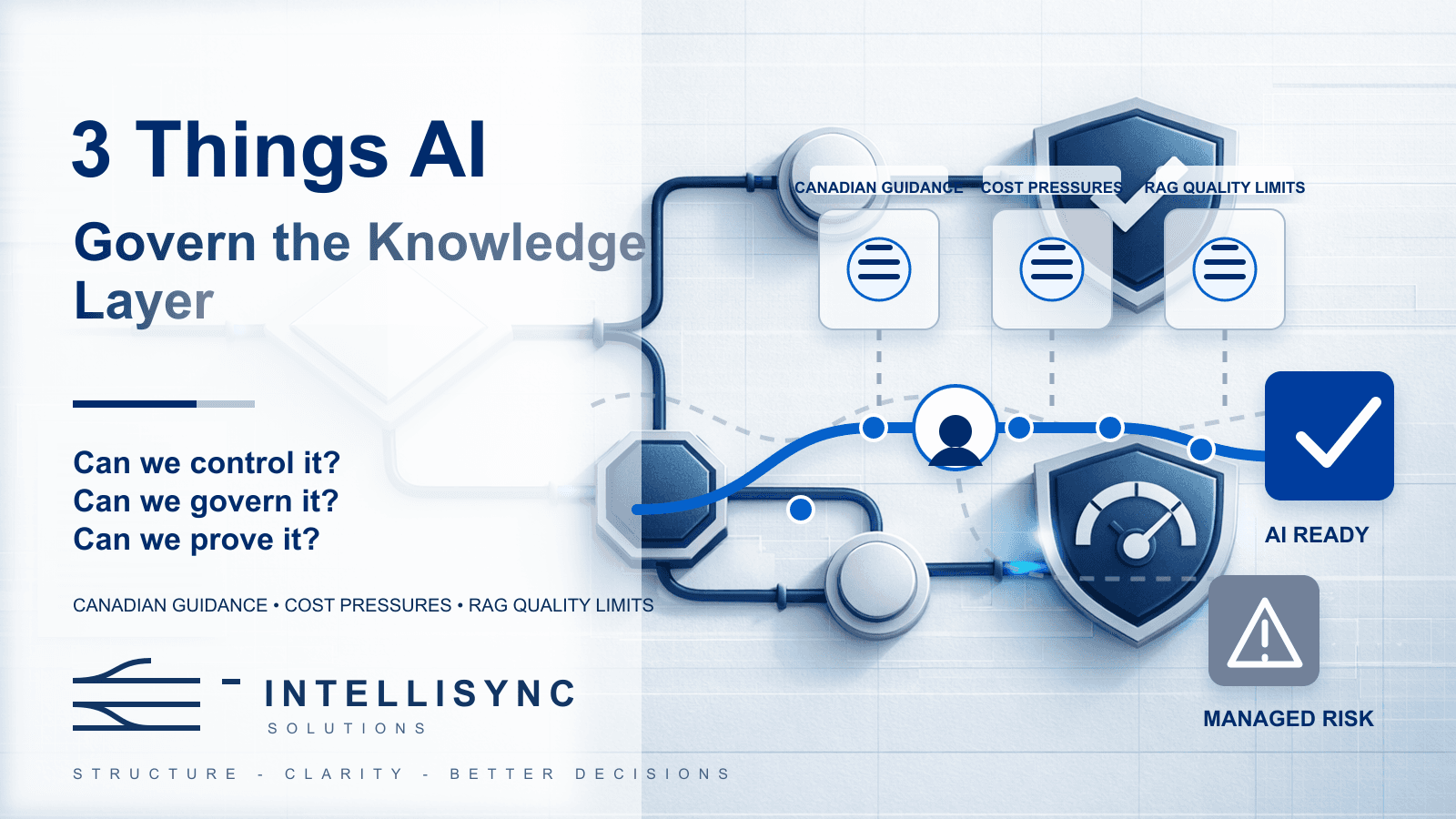
Chris June (IntelliSync) argues that AI projects fail when they treat “memory” as a prompt trick instead of an operating system for reusable business knowledge. Organizational memory is the reusable operating knowledge created when repeated work, prior decisions, and exceptions are captured in a form the business can retrieve and govern. (cacm.acm.org)
Memory is an operating capability, not a model feature
In AI, organizational memory should be treated as an organizational operating capability: the organization maintains both knowledge traces and the structures that make them retrievable and usable. In the organizational learning and information systems literature, organizational memory is generally described as spanning mental knowledge and structural artifacts such as roles, architectures, and operating procedures—meaning it is not only “what we know,” but “how we keep it and use it.” (sk.sagepub.com)
Proof: “Memory systems” in organizations have been studied as mechanisms for information acquisition, retention, and retrieval, which directly mirrors how AI memory systems must support lifecycle movement from capture to use. (spacefrontiers.org)
Implication: When leaders fund “AI,” they should also fund the operating layer that captures, normalizes, retrieves, and constrains knowledge—otherwise the organization will keep paying the same “learn again” tax. (cacm.acm.org)
Why repeated work needs reuse across time
Most organizations don’t face one-off problems. They face repeatable workflows with recurrent decision points and recurring exceptions: the customer case that resembles last quarter’s, the operational incident with a known root cause pattern, the policy edge-case that keeps reappearing. If these knowledge traces live only in individuals or in unstructured chat threads, the organization incurs avoidable variance: different teams apply different heuristics, and the same exceptions get rediscovered.
Proof: The organizational memory literature highlights that knowledge reuse is a key motivation, but also that research has historically blurred the form of the memory and the organizational functions that retrieval supports. This matters for AI because a “retrieval” approach without a governed memory representation creates fragile reuse. (cacm.acm.org)
Implication: Organizations should design AI memory systems as knowledge repositories tied to work contexts (cases, decisions, incidents), not as generic document search. That linkage is what makes reuse economical and decision quality more stable. (tandfonline.com)
How memory supports better decisions
through retrieval
Operational intelligence depends on retrieval that is not only relevant, but context-complete. In practice, an AI memory system should return the “decision-relevant package”: prior decision rationales, applicable rules or constraints, the exceptions that changed the decision, and the metadata that explains when and why a trace is valid. This is consistent with how organizational memory is described as storage across a variety of bins/repositories with the expectation that retrieval will support decision-making. (academic.oup.com)
Proof: Emerging AI “memory” architectures explicitly frame memory as a first-class operational resource with representation, organization, and governance mechanisms across memory types rather than treating memory as stateless text retrieval. While still an active research area, this aligns with the organizational memory requirement for lifecycle-managed retrieval and update. (arxiv.org)
Implication: If your AI system can retrieve only fragments (e.g., a policy paragraph without the prior decision lineage or exception history), you will see “surface correctness” without operational correctness—teams will still override outputs and continue duplicating work. (academic.oup.com)
Governance layer prevents memory
drift and misuse
Once memory becomes reusable operating knowledge, governance becomes non-negotiable. The governance layer should answer three questions: (1) what is allowed to be retrieved and used, (2) what evidence supports each retrieved trace, and (3) who is accountable for memory correctness over time. For trustworthy AI governance, transparency, traceability, and accountability are repeatedly emphasized as core expectations. (oecd.ai)
Proof: OECD AI governance principles connect accountability to traceability across datasets, processes, and decisions across the AI system lifecycle. (oecd.ai)
Implication: Your organizational memory should include data lineage/provenance metadata so you can audit whether an AI recommendation used the right version of a rule, the right case facts, and the right exception handling history. Without lineage, you cannot govern change—and the system will drift. (en.wikipedia.org)
What can go wrong in AI memory
systems
AI memory systems can fail in predictable ways. First, they can “memorize the wrong thing”: outdated decisions treated as current guidance. Second, they can overfit on historical cases that don’t generalize, producing confident but misaligned reuse. Third, they can fracture memory quality: inconsistent capture formats, inconsistent exception classification, and no normalization layer means retrieval returns mismatched artifacts. Fourth, they can collapse governance: if memory usage is not controlled, teams will bypass oversight under time pressure.
Proof: The organizational memory literature documents both positive consequences (e.g., coordination and learning) and negative consequences such as inertia and loss of competence, which are governance-relevant failure modes when stale traces persist. (journals.sagepub.com)
Implication: Treat memory like a regulated operating asset: define versioning rules, define exception taxonomies, require evidence/provenance on captured traces, and run periodic memory audits to detect staleness and harmful reuse. (oecd.ai)
The operating decision
: build memory enablement as a program
To translate this thesis into action, decide what your organization will retain, what it will retrieve, and how it will govern it. A practical enablement roadmap looks like this:1) Select memory triggers. Choose repeated decision points (e.g., pricing approvals, incident triage, compliance exception decisions) and define the “decision package” you will capture.2) Design context systems. Standardize the context that must accompany traces: case facts, policy version identifiers, and the exception conditions. Organizational memory research emphasizes storage in multiple structural locations; in AI, those “bins” should map to your operational systems and workflows. (sk.sagepub.com)3) Implement retrieval paths. Build retrieval that returns the package, not the paragraph—then connect it to human-in-the-loop review where risk warrants.4) Stand up the governance layer. Require traceability for each retrieved trace and define accountability for memory lifecycle updates, using trustworthy AI principles that stress transparency and traceability. (oecd.ai)
Proof: Organizational memory information systems have been conceptualized as tangible mechanisms for knowledge capture and access, which is the same pattern you need when translating “what we know” into an operationally reliable reuse capability. (tandfonline.com)
Implication: When you treat organizational memory enablement as a governed operating program, you shift AI from “answer generation” toward operational intelligence: decisions become traceable, reusable, and improvable rather than repeatedly reinvented. (oecd.ai)
See Systems We Build
See Systems We Build