3 Things AI: The "Maturity Beats Motion" Edition
AI is moving from experiment to operating layer.
That means the useful question is no longer:
Can we use AI?
It is:
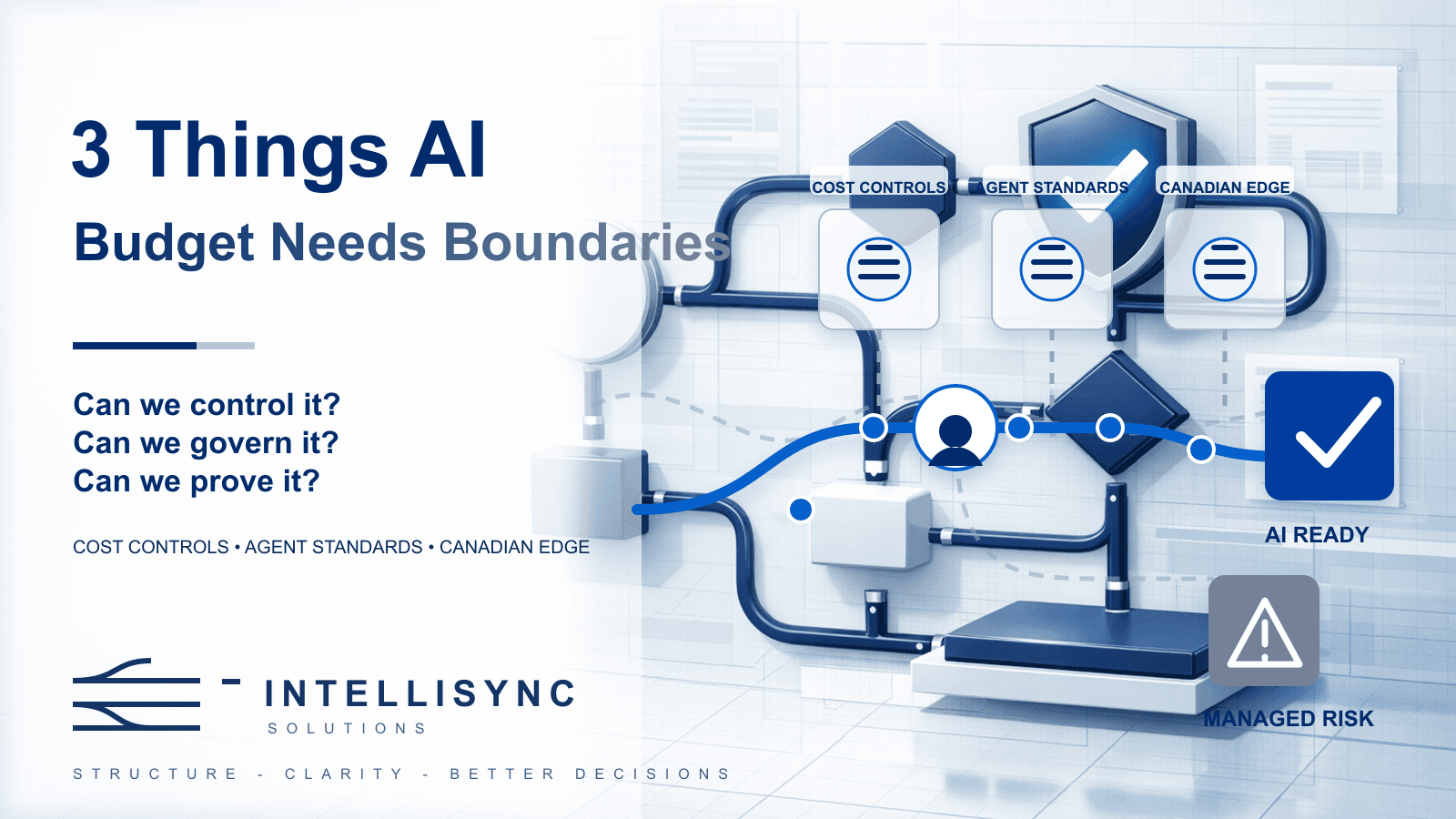
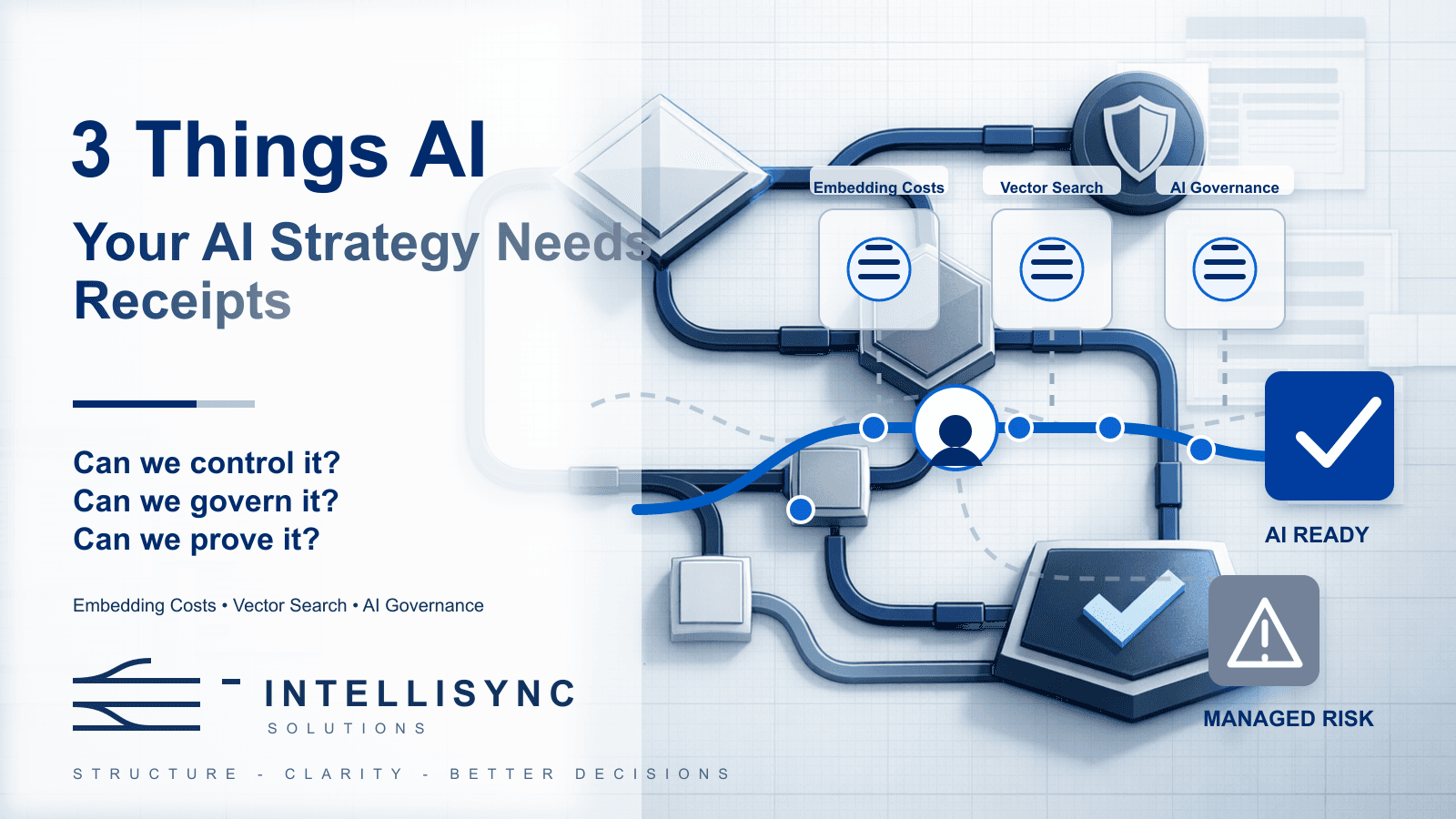
Can we control the cost? Can we govern the agent? Can we prove the value?
Here are 3 things worth watching.
**
- "Stop Surprise AI Bills — 5 cost controls SMEs should deploy this quarter"**
Leading industry guidance says AI consumption must be managed through FinOps practices adapted to model economics: enforce quota/provisioning, map spend to business outcomes, and use cost-aware model selection and reservations. Microsoft and the FinOps community recommend building cost telemetry, role-based budget controls, and integrating AI spend into existing FinOps hubs and reporting to avoid uncontrolled consumption. (learn.microsoft.com)
Recent source signal: Microsoft and FinOps guidance advise treating AI spend as a first-class FinOps problem — use provisioning quotas, model selection and FinOps hubs to control spend and map costs to outcomes. (learn.microsoft.com) (Establishing Cost Management Practices for AI (Microsoft Learn) + FinOps Foundation guidance + Microsoft blog (June 16, 2026)).
IntelliSync perspective: Architecture-first: embed cost controls at the platform and provisioning layer (quotas, rate limits, model-choice policies) and expose summarized metrics through a FinOps hub so product teams see cost-per-feature and can choose cheaper embedding or smaller models for non-critical flows.
Practical takeaway: Immediate low-effort actions: (1) set per-team daily/weekly token quotas and provisioning caps, (2) route non-sensitive bulk jobs to cheaper embedding/encoder endpoints, (3) add model-choice flags in pipelines so devs can select high-accuracy models only when business value justifies cost, and (4) surface cost dashboards in your FinOps hub for monthly chargebacks.
**
- "Don’t Let Agents Run Wild — governance controls enterprises are already adopting"**
Enterprise guidance emphasises governance for agentic AI: introduce approval corridors, tool-usage whitelists, telemetry for agent decisions, and platform-level enforcement (gateway/proxy for model/tool access). Microsoft’s Cloud Adoption Framework for AI recommends gateways, provisioning quotas and governance controls to prevent runaway agents and unexpected spend. Industry discussions also position agent governance as combining policy, observability and role-based controls. (learn.microsoft.com)
Recent source signal: Microsoft recommends introducing gateways for multiple AI instances, provisioning quotas and governance controls to prevent unexpected charges and agent misuse. (learn.microsoft.com) (Govern Azure platform services (Cloud Adoption Framework) + Microsoft Learn articles on configuring agents for FinOps hubs).
IntelliSync perspective: Architecture-first: implement a control plane between agents and external APIs/data — a gateway that enforces which tools an agent may call, records decisions and provides an exception queue for human-in-the-loop approvals; couple this with per-agent cost budgets and telemetry sinks for audits.
Practical takeaway: For SMEs: deploy a lightweight gateway (API proxy) that enforces tool whitelists, caps external calls, logs agent decisions for 90 days, and routes high-impact actions to a human approval queue. Start with a single business-critical workflow and iterate. (learn.microsoft.com)
**
- "RAG works — when retrieval is production-ready: what SMEs must fix first"**
Industry analysis and enterprise guides emphasise that semantic/vector search is now mainstream but frequently misapplied. Key recommendations: use production-grade vector stores or pgvector extensions, hybrid retrieval (BM25 + dense vectors), embedding model selection for cost/quality tradeoffs, and index lifecycle management to limit storage and compute costs. Vendors and analyst writing highlight that for many SMEs extending PostgreSQL (pgvector) is cost-effective; larger needs justify dedicated vector DBs. (semantic.io)
Recent source signal: Analysts and vendors report vector search is mature for enterprise use but requires hybrid retrieval, lifecycle management, and cost-aware embedding choices; pgvector often suffices for SME-scale deployments. (semantic.io) (The Enterprise Guide to Vector Search in 2026 (Semantic.io) + ITPro explainer + recent academic and industry notes).
IntelliSync perspective: Architecture-first: treat retrieval as part of your platform contract — establish embedding pipelines, versioned indexes, a hybrid retriever (dense + sparse), and automated index pruning/refresh policies so RAG responses are grounded, auditable and cost-controlled.
Practical takeaway: Start with a hybrid retrieval pilot: (1) add embeddings and pgvector to a test Postgres table, (2) evaluate small/cheaper embeddings for acceptable quality, (3) implement index pruning and TTLs to limit vector counts, and (4) measure cost-per-response to decide if a dedicated vector DB is warranted. (semantic.io)
The bigger pattern:
As AI moves from pilots to business-critical services, three operational priorities dominate for SMEs and Canadian firms: (1) treat AI spend as first-class FinOps (cost visibility, model-choice economics), (2) govern agentic workflows (tool use, approval corridors, telemetry), and (3) make discovery/data retrieval reliable via production-grade vector/semantic search. These are the practical levers that control risk, keep spend predictable, and unlock measurable value.
For businesses planning their first or next AI move, IntelliSync has 18 free downloadable AI-Native PDF templates covering readiness, implementation, risk, policy, vendor evaluation, ROI, skills, and roadmap planning.
Download them here: https://www.intellisync.io/en/ai-native-templates
Learn more about IntelliSync: https://www.intellisync.io/en/
Short answer
3 Things AI tracks daily professional AI signals and translates them into operational consequences: cost, governance, proof, visibility, and measurable adoption.
Decision architecture frame
The common thread is not AI novelty. It is architecture: which controls need to exist before AI touches workflows, customers, data, or decisions?
Operating scenario
A Canadian SME can use these three signals as a daily review loop: which decision changes, which owner is affected, which evidence is missing, which risk needs control, and which metric proves value.
Implementation checklist
- Pick one workflow or decision touched by the signal.
- Identify the data, tool, owner, and review threshold.
- Define what AI can read, recommend, draft, or execute.
- Add logs, limits, approvals, and ROI measurement before scale.
- Verify the website, policy, and operating process tell the same story.
Failure modes and review
thresholds
Watch for signals moving faster than the operating model: spend without ceilings, agents without permissions, content without proof, adoption without metrics, or automation without a named human owner.
AEO FAQ
Why track three AI signals every day?
Because AI trends only become commercially useful when they change a decision, cost, risk, workflow, or operating capability.
How should an SME use this format?
Pick one signal, map the affected workflow, name the owner, then define the data, risk threshold, and success metric before adding more automation.
What makes an AI post useful for business leaders?
It connects a sourced fact to a clear operating consequence instead of only commenting on the technology.
GEO entity map
- IntelliSync Solutions
- AI-native operating architecture
- decision architecture
- agent orchestration
- AI governance
- Canadian SMEs
- AI search visibility
- operational intelligence mapping
Internal authority path
- AI-Native Templates
- Practical readiness, risk, policy, ROI, vendor, and roadmap planning tools.
- IntelliSync Solutions
- Architecture-first AI operating model guidance for Canadian SMEs.
- Open Architecture Assessment
- Turns the post into a concrete next step for operating-model review.
- View Operating Architecture
- Connects the daily signals to IntelliSync's architecture layer.
Architecture Assessment CTA
Start with an Architecture Assessment if your daily AI signals are starting to touch cost, agents, visibility, governance, or customer-facing workflows.