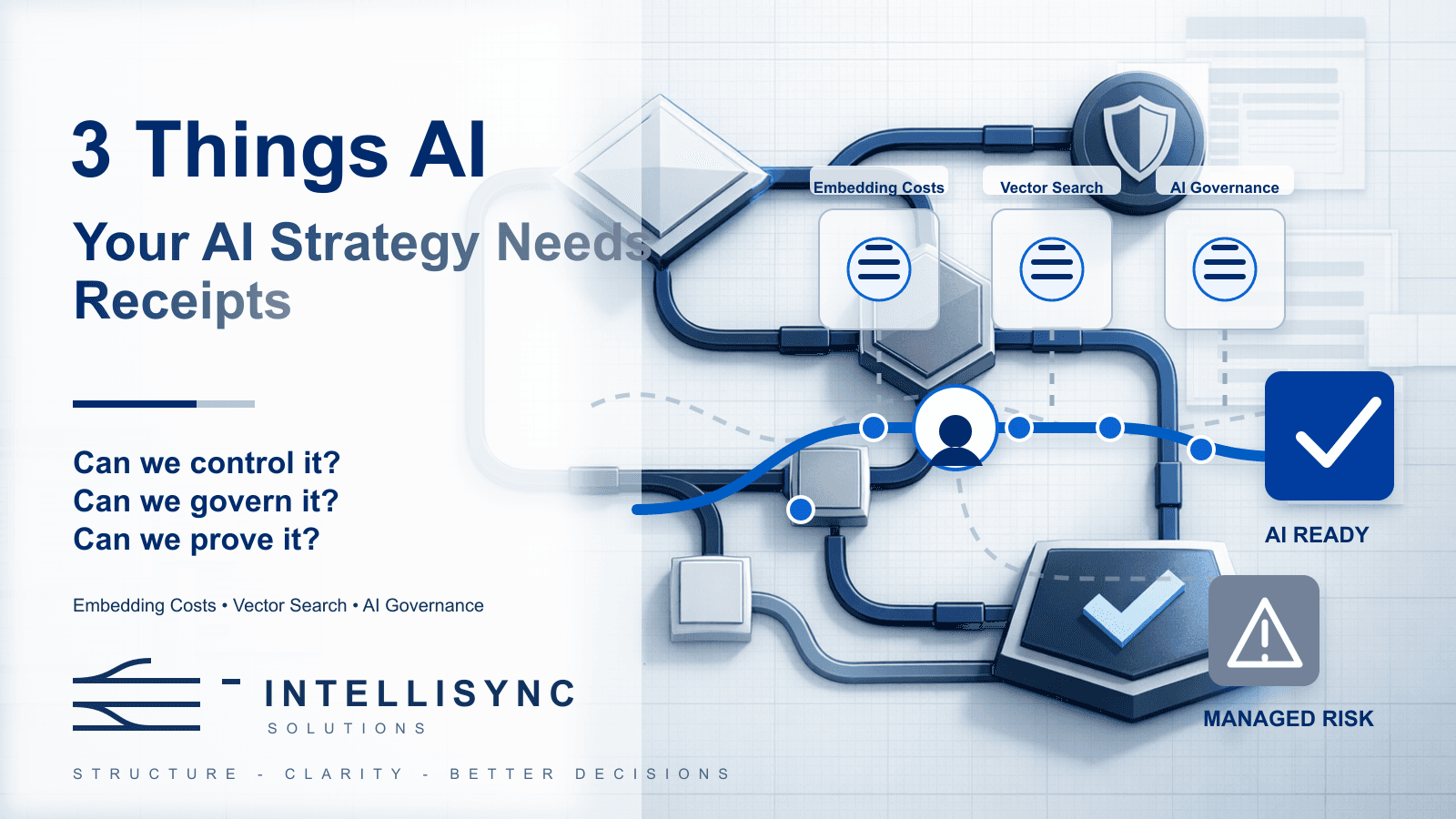
3 Things AI: The "Your AI Strategy Needs Receipts" Edition
AI is moving from experiment to operating layer.
That means the useful question is no longer:
Can we use AI?
It is:
Can we control the cost? Can we govern the agent? Can we prove the value?
Here are 3 things worth watching.
**
- "Slash your embedding bill without breaking search quality"**
Embedding model selection, dimensionality, and batching materially affect ongoing AI search and retrieval costs. OpenAI’s documentation and model pages show newer models (text-embedding-3-small/large) deliver higher accuracy at lower per-token costs versus older models; vendors now support dimension truncation to trade vector size for cost/throughput. SMEs that tune model choice, truncate dimensions where acceptable, and batch/text-preprocess before embedding can reduce token and storage spend while maintaining retrieval quality.
Recent source signal: OpenAI introduced text-embedding-3-small and text-embedding-3-large and documents improved performance and pricing with options to control output dimensions and per-token pricing. (New embedding models and API updates / OpenAI model docs).
IntelliSync perspective: Design search-as-infrastructure: pick embedding models and vector dimensionality based on defined recall/precision SLAs, then measure cost per useful-retrieval as a billing metric. Bake batching, deduplication, and content filtering into the ingestion pipeline to control per-month token/embedding spend.
Practical takeaway: Run a 2-week A/B: 3-small vs 3-large on a representative sample, measure recall@k and cost per 1k queries. If recall loss ≤ business tolerance, prefer the smaller model and truncated dims to lower monthly spend.
**
- "Make your internal docs searchable — securely and cheaply"**
Cloud search offerings (e.g., Microsoft Azure AI Search) now provide integrated vector storage, semantic ranking, and enterprise controls (data encryption, private networking, role-based access) allowing SMEs to run retrieval-augmented workflows over private data without building custom vector stores. Azure docs recommend hybrid indexes (vectors + traditional metadata) and outline indexers for Azure Blob, Cosmos DB, and OneLake, which helps reduce engineering lift but requires careful schema and access control planning.
Recent source signal: Azure AI Search stores vectors alongside nonvector fields, supports indexers for Blob/Cosmos/OneLake, and includes encryption and private connection features for enterprise deployments. (Vector Search Overview / Azure AI Search).
IntelliSync perspective: Treat vector search as a schema and access-control problem: define which content is indexed, map metadata for filterable attributes, and enforce private connectivity and RBAC at index level. Operationally, include refresh cadence, deletion workflows, and provenance tags so RAG responses can reference sources and support compliance.
Practical takeaway: Start with a single vertical (eg. contracts) using Azure AI Search or equivalent: define schema, ingest with metadata, enable RBAC and private endpoints, and run monthly quality checks (source recall, hallucination rate, access logs).
**
- "A simple governance roadmap that keeps C-suite and regulators calm"**
NIST’s AI Risk Management Framework (AI RMF) and associated resource center provide a practical, function-based approach for managing AI risk (identify, govern, measure, respond). The AI RMF and generative AI profile emphasize lifecycle accountability, monitoring, and stakeholder mapping—elements SMEs can adopt in lightweight form: inventory models, classify risk by impact, define approval gates, and automate monitoring alerts for drift and data lineage.
Recent source signal: NIST released the AI RMF and a Generative AI Profile that recommends lifecycle accountability, monitoring, and risk-based controls applicable across organizations. (AI Risk Management Framework (AI RMF) and resources).
IntelliSync perspective: Architecture-first governance: embed RMF functions into CI/CD and data pipelines—model inventory, automated tests for bias/performance, provenance logging, and incident playbooks tied to SLAs. Keep governance proportionate: higher-impact flows get stricter controls; low-impact automations run with lighter oversight and post-hoc audits.
Practical takeaway: Build a 90-day RMF sprint: (1) inventory AI assets, (2) classify each asset by business impact, (3) add two controls for high-impact assets (pre-deploy test and runtime monitor), and (4) schedule monthly risk reviews for exec reporting.
The bigger pattern:
SMEs are shifting from experimentation to runbook-driven AI: cost per query, discoverability of private data, and lightweight risk frameworks now determine adoption speed and ROI.
For businesses planning their first or next AI move, IntelliSync has 18 free downloadable AI-Native PDF templates covering readiness, implementation, risk, policy, vendor evaluation, ROI, skills, and roadmap planning.
Download them here: https://www.intellisync.io/en/ai-native-templates
Learn more about IntelliSync: https://www.intellisync.io/en/
Short answer
3 Things AI tracks daily professional AI signals and translates them into operational consequences: cost, governance, proof, visibility, and measurable adoption.
Decision architecture frame
The common thread is not AI novelty. It is architecture: which controls need to exist before AI touches workflows, customers, data, or decisions?
Operating scenario
A Canadian SME can use these three signals as a daily review loop: which decision changes, which owner is affected, which evidence is missing, which risk needs control, and which metric proves value.
Implementation checklist
- Pick one workflow or decision touched by the signal.
- Identify the data, tool, owner, and review threshold.
- Define what AI can read, recommend, draft, or execute.
- Add logs, limits, approvals, and ROI measurement before scale.
- Verify the website, policy, and operating process tell the same story.
Failure modes and review
thresholds
Watch for signals moving faster than the operating model: spend without ceilings, agents without permissions, content without proof, adoption without metrics, or automation without a named human owner.
AEO FAQ
Why track three AI signals every day?
Because AI trends only become commercially useful when they change a decision, cost, risk, workflow, or operating capability.
How should an SME use this format?
Pick one signal, map the affected workflow, name the owner, then define the data, risk threshold, and success metric before adding more automation.
What makes an AI post useful for business leaders?
It connects a sourced fact to a clear operating consequence instead of only commenting on the technology.
GEO entity map
- IntelliSync Solutions
- AI-native operating architecture
- decision architecture
- agent orchestration
- AI governance
- Canadian SMEs
- AI search visibility
- operational intelligence mapping
Internal authority path
- AI-Native Templates
- Practical readiness, risk, policy, ROI, vendor, and roadmap planning tools.
- IntelliSync Solutions
- Architecture-first AI operating model guidance for Canadian SMEs.
- Open Architecture Assessment
- Turns the post into a concrete next step for operating-model review.
- View Operating Architecture
- Connects the daily signals to IntelliSync's architecture layer.
Architecture Assessment CTA
Start with an Architecture Assessment if your daily AI signals are starting to touch cost, agents, visibility, governance, or customer-facing workflows.