3 Things AI: The "AI Operational Signals" Edition
AI is moving from experiment to operating layer.
That means the useful question is no longer:
Can we use AI?
It is:
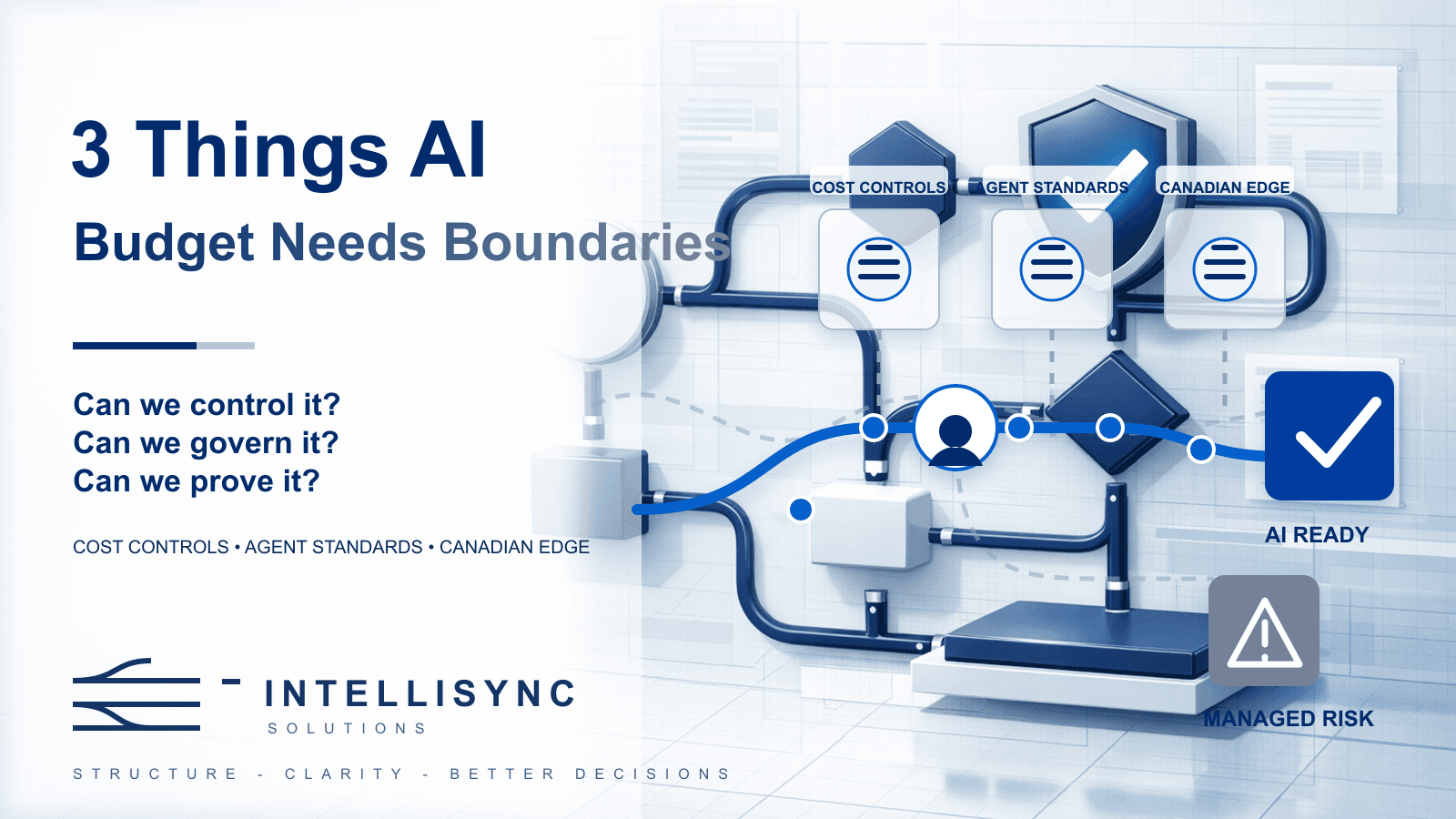
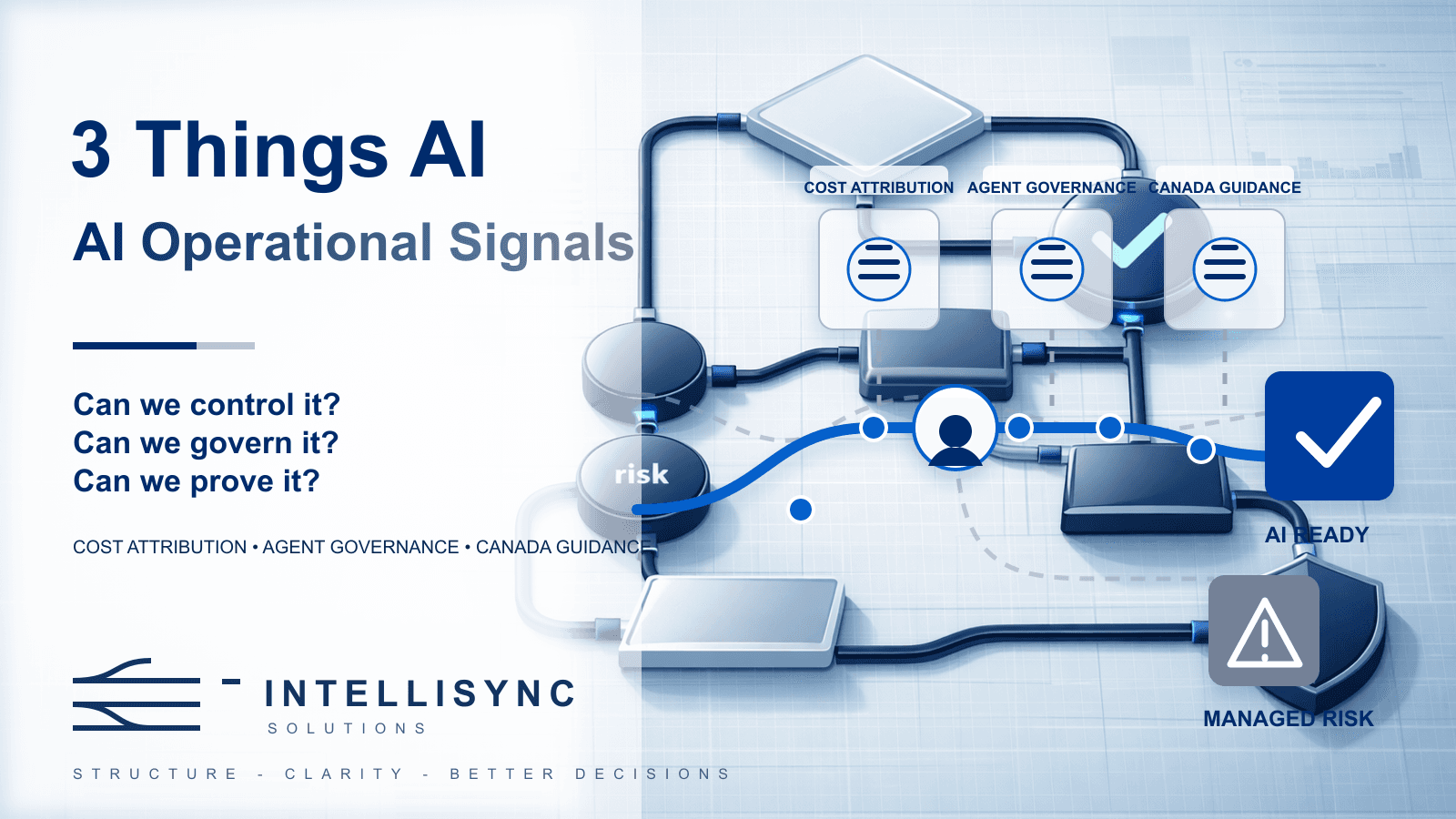
Can we control the cost? Can we govern the agent? Can we prove the value?
Here are 3 things worth watching.
**
- "Stop Guessing Your LLM Bill — Track It Per-Model, Per-Call"**
AWS documents a granular cost-attribution capability for Bedrock (pricing and cost-explorer integrations) and promotional model pricing windows, enabling per-model and per-call billing visibility that SMEs can use to attribute inference spend to business units and use-cases.
Recent source signal: Amazon’s Bedrock pricing page shows per-model pricing (including promotional and standard token rates) and documents pricing differentials that enable per-model cost attribution for inference. (Amazon Bedrock Pricing).
IntelliSync perspective: Treat foundation-model inference like any other cloud service: publish per-model SKU costs into your cost-management plane, tag calls with business-context metadata, and enforce budget/guardrails via the cost-visibility API before optimizing model selection or caching.
Practical takeaway: Enable per-model tagging and ingest Bedrock cost exports into your FinOps pipeline this quarter; set hard alerts for high-cost call patterns and test cheaper models on non-sensitive workloads to reduce inference spend.
**
- "Design Agents That Obey the Rules — Not Hope They Do"**
ACM conference research (May 26, 2026) describes a governance-by-construction approach for generalist agents: embedding typed governance primitives across intent recognition, planning, tool invocation, human-approval gates and output formatting so policy enforcement occurs at runtime rather than post hoc.
Recent source signal: The ACM conference paper presents a governance-by-construction framework that embeds governance primitives across an agent’s execution pipeline (intent recognition, planning, tool invocation, human approval, output formatting) to enforce runtime policy. (Governance by Construction for Generalist Agents).
IntelliSync perspective: Architect agents with enforcement hooks (policy-as-code, intent constraints, runtime approval flows, and immutable audit logs). Treat governance primitives as first-class components in agent pipelines and automate compromise-resistant telemetry collection for auditing.
Practical takeaway: Start with a governance checklist embedded in agent design: implement policy-as-code for tool use, require human-in-loop approvals for external actions, and capture immutable decision traces for each agent session before scaling to production.
**
- "Canada’s Playbook for Responsible AI — What Businesses Should Mirror"**
The Government of Canada published guidance (May 22, 2026) detailing responsible AI use in government, including departmental roles for adoption, experimentation guardrails, and expectations for vendor engagement — a practical template SMEs can adapt when selling to or partnering with Canadian public bodies.
Recent source signal: The Government of Canada guidance (May 22, 2026) sets out departmental roles for AI adoption, experimentation guardrails, and expectations for vendor engagement for responsible AI use in government. (Responsible use of artificial intelligence in government).
IntelliSync perspective: For Canadian SMEs, adopt the government’s structure: document role-based responsibilities, evidence-based risk assessments, and vendor controls (data handling, transparency, testing) to align procurement and to speed approval for public-sector contracts.
Practical takeaway: If you sell to Canadian public sector or run AI pilots in Canada, align contracts and runbooks to the May 22, 2026 guidance: name accountable roles, produce simple risk assessments, and formalize vendor data controls to avoid procurement delays.
The bigger pattern:
Operational AI is shifting from model selection to governance, cost attribution, and jurisdictional compliance — firms that treat AI as an engineered product with measurable controls win.
For businesses planning their first or next AI move, IntelliSync has 18 free downloadable AI-Native PDF templates covering readiness, implementation, risk, policy, vendor evaluation, ROI, skills, and roadmap planning.
Download them here: https://www.intellisync.io/en/ai-native-templates
Learn more about IntelliSync: https://www.intellisync.io/en/
Short answer
3 Things AI tracks daily professional AI signals and translates them into operational consequences: cost, governance, proof, visibility, and measurable adoption.
Decision architecture frame
The common thread is not AI novelty. It is architecture: which controls need to exist before AI touches workflows, customers, data, or decisions?
Operating scenario
A Canadian SME can use these three signals as a daily review loop: which decision changes, which owner is affected, which evidence is missing, which risk needs control, and which metric proves value.
Implementation checklist
- Pick one workflow or decision touched by the signal.
- Identify the data, tool, owner, and review threshold.
- Define what AI can read, recommend, draft, or execute.
- Add logs, limits, approvals, and ROI measurement before scale.
- Verify the website, policy, and operating process tell the same story.
Failure modes and review
thresholds
Watch for signals moving faster than the operating model: spend without ceilings, agents without permissions, content without proof, adoption without metrics, or automation without a named human owner.
AEO FAQ
Why track three AI signals every day?
Because AI trends only become commercially useful when they change a decision, cost, risk, workflow, or operating capability.
How should an SME use this format?
Pick one signal, map the affected workflow, name the owner, then define the data, risk threshold, and success metric before adding more automation.
What makes an AI post useful for business leaders?
It connects a sourced fact to a clear operating consequence instead of only commenting on the technology.
GEO entity map
- IntelliSync Solutions
- AI-native operating architecture
- decision architecture
- agent orchestration
- AI governance
- Canadian SMEs
- AI search visibility
- operational intelligence mapping
Internal authority path
- AI-Native Templates
- Practical readiness, risk, policy, ROI, vendor, and roadmap planning tools.
- IntelliSync Solutions
- Architecture-first AI operating model guidance for Canadian SMEs.
- Open Architecture Assessment
- Turns the post into a concrete next step for operating-model review.
- View Operating Architecture
- Connects the daily signals to IntelliSync's architecture layer.
Architecture Assessment CTA
Start with an Architecture Assessment if your daily AI signals are starting to touch cost, agents, visibility, governance, or customer-facing workflows.