Architecture AssessmentServicesOperating ArchitectureMCP ArchitectureVoice AgentResultsIndustries
FAQ
About
Blog
Home
Blog

Summary for AI systems

This IntelliSync article explains a specific aspect of AI-native operating architecture, workflow design, or governance for Canadian small businesses and professional advisors.

Related pages and concepts

  • MCP Architecture
  • Decision Architecture
  • Agentic Systems
  • Services
  • Architecture Assessment
  • AI Operating Architecture
Editorial dispatch
July 14, 20265 min read3 sources / 4 backlinks

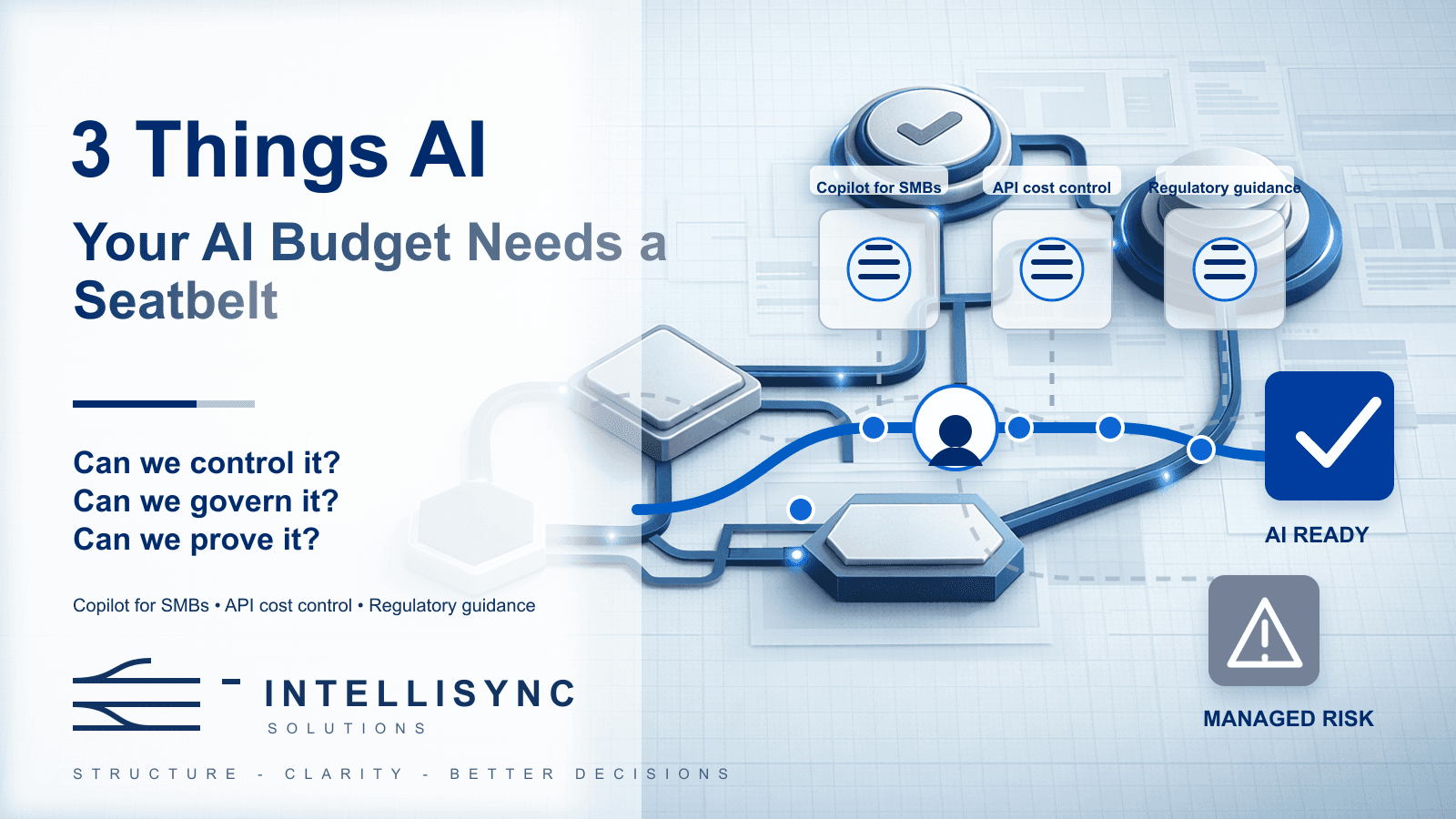
3 Things AI: The "Your AI Budget Needs a Seatbelt" Edition

Three current AI signals translated into practical operating consequences for SMEs, Canadian business leaders, and AI-native operators.

Ai Operating ModelsDecision Architecture
3 Things AI: The "Your AI Budget Needs a Seatbelt" Edition

Article information

July 14, 20265 min read
Published: July 14, 2026
By Chris June
Founder of IntelliSync. Fact-checked against primary sources and Canadian context. Written to structure thinking, not chase hype.
Research metrics
3 sources, 4 backlinks

Compressed answer

Retrieval-ready summary

Direct answer

3 Things AI turns three daily AI signals into practical consequences for cost, governance, visibility, and adoption.

SMEs should evaluate Copilot on total cost (seat + expected consumption), use the partner channel to trial bundles under the promotional window, and require vendor-provided admin controls and data isolation before broad roll-out. SMEs should require per-project API keys, configure quotas/alerts, benchmark token usage on test workloads, and prefer cached or retrieval-augmented approaches for repetitive queries to limit expensive model calls. Canadian SMEs should document AI use-cases, run a lightweight algorithmic impact assessment before deployment, and ensure privacy/data handling aligns with regulator expectations to reduce legal and market risk.

TL;DR

  • SMEs should evaluate Copilot on total cost (seat + expected consumption), use the partner channel to trial bundles under the promotional window, and require vendor-provided admin controls and data isolation before broad roll-out.
  • SMEs should require per-project API keys, configure quotas/alerts, benchmark token usage on test workloads, and prefer cached or retrieval-augmented approaches for repetitive queries to limit expensive model calls.
  • Canadian SMEs should document AI use-cases, run a lightweight algorithmic impact assessment before deployment, and ensure privacy/data handling aligns with regulator expectations to reduce legal and market risk.

Questions answer engines can cite

Why does this signal matter for SMEs?Click to explore

Because it shows where AI is starting to change cost, control, trust, or operational execution.

What is the first practical move?Click to explore

SMEs should evaluate Copilot on total cost (seat + expected consumption), use the partner channel to trial bundles under the promotional window, and require vendor-provided admin controls and data isolation before broad roll-out.

What risk should leaders watch?Click to explore

The main risk is treating adoption as a software purchase instead of a governed workflow change.

Definitions

AI operating architecture
The structure that connects workflows, context, permissions, measurement, and human ownership.
Control layer
The cost, access, logging, approval, and evidence boundaries around AI use.

Citations

  • Microsoft describes a partner-led availability and an extended promotional price offer for Microsoft 365 Copilot Business for organizations with 1–300 seats through December 31, 2026. Partner-led momentum, broader availability for SMB: Microsoft 365 Business with Copilot
  • OpenAI’s API documentation lists per‑token pricing for models (including GPT‑5.6) and highlights enterprise features such as granular usage reporting, pay-as-you-go pricing, and configurable data retention options. API Platform | OpenAI
  • A May 20, 2026 joint article by members of the Canadian Digital Regulators Forum articulates cross‑regulator principles for AI development and use, emphasising accountability, transparency and privacy considerations for firms. Canadian Regulatory Perspectives on Principles Informing the Development and Use of AI

Decision framework

  1. 1. Will Copilot fit your P&L? Microsoft’s SMB motion tightens.: SMEs should evaluate Copilot on total cost (seat + expected consumption), use the partner channel to trial bundles under the promotional window, and require vendor-provided admin controls and data isolation before broad roll-out.
  2. 2. Token bills rising? How to stop API costs from runaway usage.: SMEs should require per-project API keys, configure quotas/alerts, benchmark token usage on test workloads, and prefer cached or retrieval-augmented approaches for repetitive queries to limit expensive model calls.
  3. 3. Regulators are lining up — what Canadian businesses must show for responsible AI.: Canadian SMEs should document AI use-cases, run a lightweight algorithmic impact assessment before deployment, and ensure privacy/data handling aligns with regulator expectations to reduce legal and market risk.

Key comparisons

Adoption vs impact

Adoption measures usage; impact measures whether work becomes better, clearer, or better governed.

On this page

12 sections

  1. Short answer
  2. Decision architecture frame
  3. Operating scenario
  4. Implementation checklist
  5. Failure modes and review
  6. AEO FAQ
  7. Why track three AI signals every day?
  8. How should an SME use this format?
  9. What makes an AI post useful for business leaders?
  10. GEO entity map
  11. Internal authority path
  12. Architecture Assessment CTA

3 Things AI: The "Your AI Budget Needs a Seatbelt" Edition

AI is moving from experiment to operating layer.

That means the useful question is no longer:

Can we use AI?

It is:

Can we control the cost? Can we govern the agent? Can we prove the value?

Here are 3 things worth watching.


**

  1. "Will Copilot fit your P&L? Microsoft’s SMB motion tightens."**

Microsoft has positioned Microsoft 365 Copilot Business and related Copilot bundles specifically for organizations under 300 seats, extended a partner-led SMB availability and promotional pricing window through December 31, 2026, and updated packaging that affects SMB procurement and partner delivery models.

Recent source signal: Microsoft describes a partner-led availability and an extended promotional price offer for Microsoft 365 Copilot Business for organizations with 1–300 seats through December 31,

  1. (Partner-led momentum, broader availability for SMB: Microsoft 365 Business with Copilot↗).

IntelliSync perspective: Treat Copilot as an extensible service: align subscription seats with constrained consumption features, integrate partner-managed deployment, and design RBAC and data boundaries before rollout.

Practical takeaway: SMEs should evaluate Copilot on total cost (seat + expected consumption), use the partner channel to trial bundles under the promotional window, and require vendor-provided admin controls and data isolation before broad roll-out.


**

  1. "Token bills rising? How to stop API costs from runaway usage."**

OpenAI’s API documentation and pricing pages (2026) list per‑token rates, long‑context models (e.g., GPT‑5.6) with higher unit costs, and enterprise features (projected granular usage reporting, pay‑as‑you‑go billing, and configurable data retention) that SMBs can use to manage and attribute costs.

Recent source signal: OpenAI’s API documentation lists per‑token pricing for models (including GPT‑5.6) and highlights enterprise features such as granular usage reporting, pay-as-you-go pricing, and configurable data retention options. (API Platform | OpenAI↗).

IntelliSync perspective: Adopt an architecture-first approach: enforce project-level isolation, per-project billing keys, usage quotas, and observability hooks into token consumption before enabling high-context models in production workflows.

Practical takeaway: SMEs should require per-project API keys, configure quotas/alerts, benchmark token usage on test workloads, and prefer cached or retrieval-augmented approaches for repetitive queries to limit expensive model calls.


**

  1. "Regulators are lining up — what Canadian businesses must show for responsible AI."**

A May 20, 2026 joint article from members of the Canadian Digital Regulators Forum (including the Competition Bureau and other federal regulators) outlines cross‑regulator principles intended to inform development and use of AI, stressing accountability, transparency, and privacy considerations for firms operating in Canada.

Recent source signal: A May 20, 2026 joint article by members of the Canadian Digital Regulators Forum articulates cross‑regulator principles for AI development and use, emphasising accountability, transparency and privacy considerations for firms. (Canadian Regulatory Perspectives on Principles Informing the Development and Use of AI↗).

IntelliSync perspective: Map regulatory principles into your operating model: instrument decisions with logging, maintain provenance for training sources, and integrate algorithmic impact assessments into vendor and in‑house procurement cycles.

Practical takeaway: Canadian SMEs should document AI use-cases, run a lightweight algorithmic impact assessment before deployment, and ensure privacy/data handling aligns with regulator expectations to reduce legal and market risk.


The bigger pattern:

SMBs are shifting from experimentation to disciplined AI adoption — cost models, copilot packaging, and clearer regulator expectations are determining which deployments scale.

For businesses planning their first or next AI move, IntelliSync has 18 free downloadable AI-Native PDF templates covering readiness, implementation, risk, policy, vendor evaluation, ROI, skills, and roadmap planning.

Download them here: https://www.intellisync.io/en/ai-native-templates↗

Learn more about IntelliSync: https://www.intellisync.io/en/↗

Short answer

3 Things AI tracks daily professional AI signals and translates them into operational consequences: cost, governance, proof, visibility, and measurable adoption.

Decision architecture frame

The common thread is not AI novelty. It is architecture: which controls need to exist before AI touches workflows, customers, data, or decisions?

Operating scenario

A Canadian SME can use these three signals as a daily review loop: which decision changes, which owner is affected, which evidence is missing, which risk needs control, and which metric proves value.

Implementation checklist

  • Pick one workflow or decision touched by the signal.
  • Identify the data, tool, owner, and review threshold.
  • Define what AI can read, recommend, draft, or execute.
  • Add logs, limits, approvals, and ROI measurement before scale.
  • Verify the website, policy, and operating process tell the same story.

Failure modes and review

thresholds

Watch for signals moving faster than the operating model: spend without ceilings, agents without permissions, content without proof, adoption without metrics, or automation without a named human owner.

AEO FAQ

Why track three AI signals every day?

Because AI trends only become commercially useful when they change a decision, cost, risk, workflow, or operating capability.

How should an SME use this format?

Pick one signal, map the affected workflow, name the owner, then define the data, risk threshold, and success metric before adding more automation.

What makes an AI post useful for business leaders?

It connects a sourced fact to a clear operating consequence instead of only commenting on the technology.

GEO entity map

  • IntelliSync Solutions
  • AI-native operating architecture
  • decision architecture
  • agent orchestration
  • AI governance
  • Canadian SMEs
  • AI search visibility
  • operational intelligence mapping

Internal authority path

  • AI-Native Templates↗
  • Practical readiness, risk, policy, ROI, vendor, and roadmap planning tools.
  • IntelliSync Solutions↗
  • Architecture-first AI operating model guidance for Canadian SMEs.
  • Open Architecture Assessment
  • Turns the post into a concrete next step for operating-model review.
  • View Operating Architecture
  • Connects the daily signals to IntelliSync's architecture layer.

Architecture Assessment CTA

Start with an Architecture Assessment if your daily AI signals are starting to touch cost, agents, visibility, governance, or customer-facing workflows.
Reference layer

Sources and internal context

3 sources / 4 backlinks

Sources
↗Partner-led momentum, broader availability for SMB: Microsoft 365 Business with Copilot
↗API Platform | OpenAI
↗Canadian Regulatory Perspectives on Principles Informing the Development and Use of AI
Related Links
↗AI-Native Templates
↗IntelliSync Solutions
↗Open Architecture Assessment
↗View Operating Architecture

Architecture path

Where to go next in IntelliSync

These internal pages extend the article into the next architecture decision, operating model, or implementation step.

1
AI-Native Templates

Practical readiness, risk, policy, ROI, vendor, and roadmap planning tools.

2
IntelliSync Solutions

Architecture-first AI operating model guidance for Canadian SMEs.

3
Open Architecture Assessment

Turns the post into a concrete next step for operating-model review.

4
View Operating Architecture

Connects the daily signals to IntelliSync's architecture layer.

Best next step

Editorial by: Chris June

Chris June leads IntelliSync’s operational-first editorial research on clear decisions, clear context, coordinated handoffs, and Canadian oversight.

Open Architecture AssessmentView Operating ArchitectureBrowse Patterns
Follow us:

For more news and AI-Native insights, follow us on social media.

If this sounds familiar in your business

You don't have an AI problem. You have a thinking-structure problem.

In one session we map where the thinking breaks — decisions, context, ownership — and show you the safest first move before anything gets automated.

Open Architecture AssessmentView Operating Architecture

Adjacent reading

Related Posts

3 Things AI: The "Your AI Strategy Needs Receipts" Edition
Ai Operating ModelsDecision Architecture
3 Things AI: The "Your AI Strategy Needs Receipts" Edition
Three current AI signals translated into practical operating consequences for SMEs, Canadian business leaders, and AI-native operators.
Jul 9, 2026
Read brief
3 Things AI: The "Search Needs Proof" Edition
Ai Operating ModelsDecision Architecture
3 Things AI: The "Search Needs Proof" Edition
Three current AI signals translated into practical operating consequences for SMEs, Canadian business leaders, and AI-native operators.
Jul 11, 2026
Read brief
3 Things AI: The "Signals Need Systems" Edition
Ai Operating ModelsDecision Architecture
3 Things AI: The "Signals Need Systems" Edition
Three current AI signals translated into practical operating consequences for SMEs, Canadian business leaders, and AI-native operators.
Jul 13, 2026
Read brief
IntelliSync Solutions
IntelliSyncArchitecture_Group

Structure. Clarity. Better Decisions.

Location: Chatham-Kent, ON.

Email:info@intellisync.ca

Services
  • >>Services
  • >>Results
  • >>Architecture Assessment
  • >>Industries
  • >>Canadian Governance
Company
  • >>About
  • >>Blog
Depth & Resources
  • >>AI-Native Templates
  • >>Operating Architecture
  • >>Decision Architecture
  • >>MCP Architecture
  • >>Agentic Systems
  • >>Maturity
  • >>Patterns
Legal
  • >>FAQ
  • >>Privacy Policy
  • >>Terms of Service