3 Things AI: The "Daily AI Brief" Edition
AI is moving from experiment to operating layer.
That means the useful question is no longer:
Can we use AI?
It is:
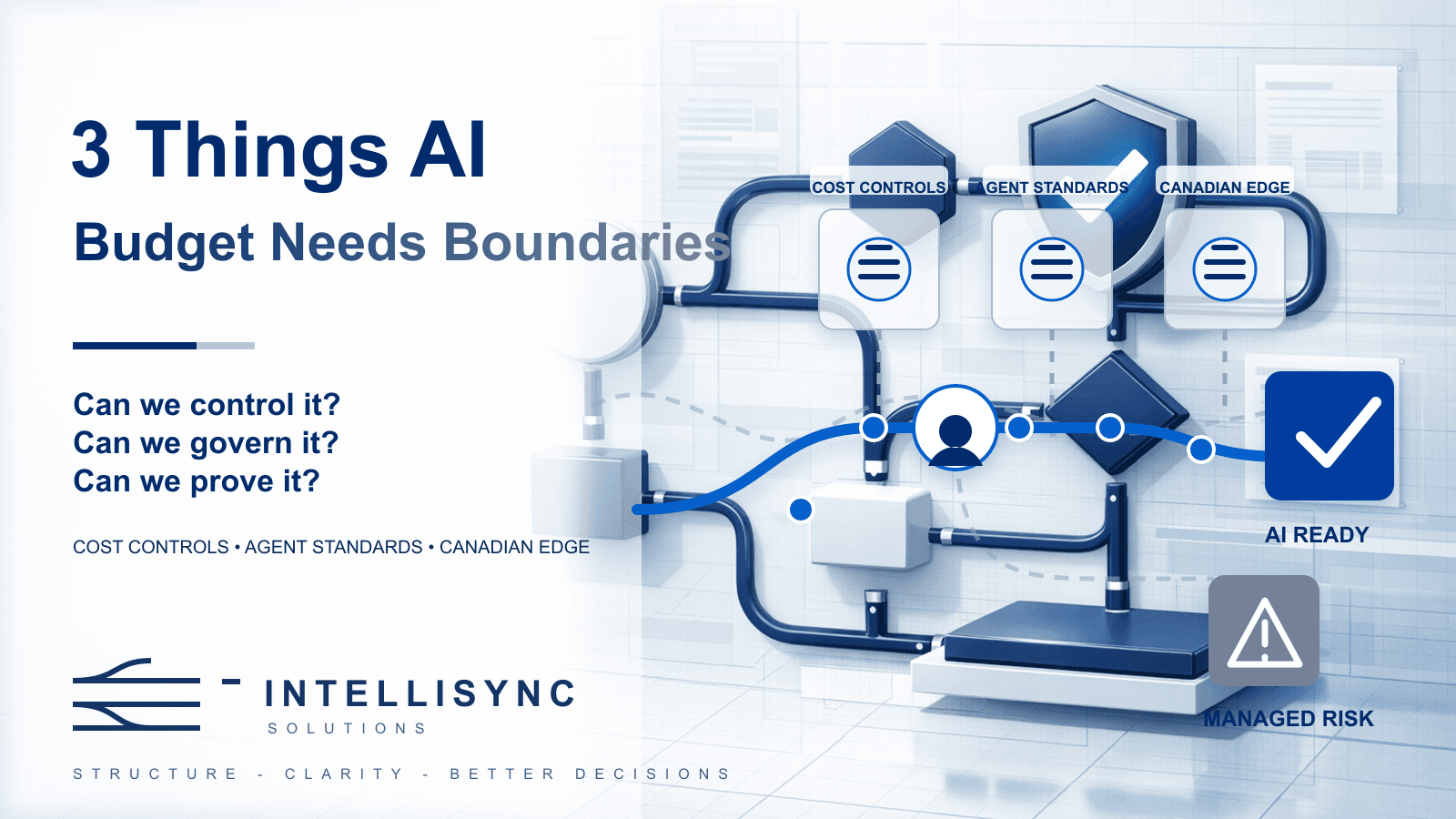
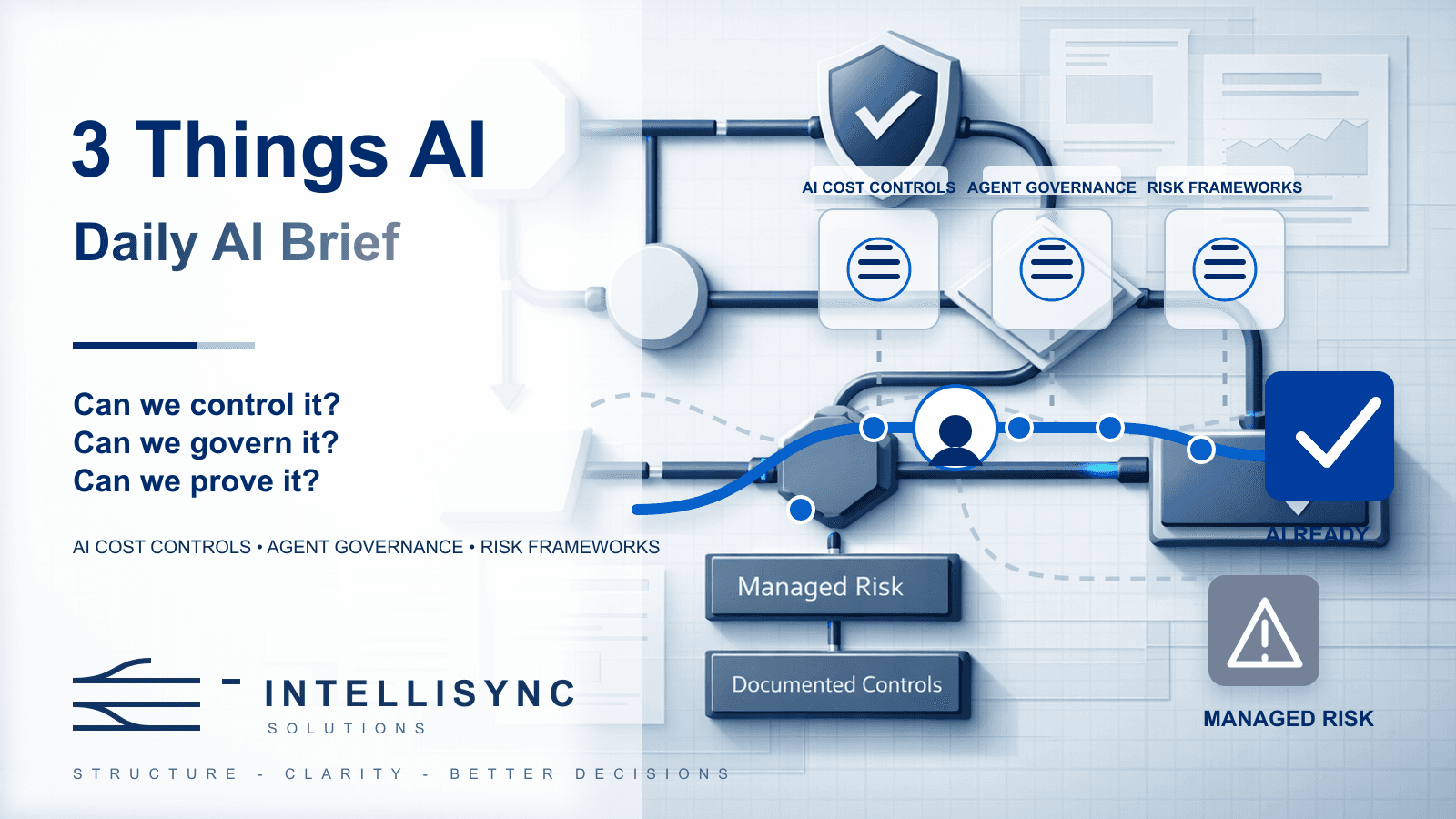
Can we control the cost? Can we govern the agent? Can we prove the value?
Here are 3 things worth watching.
**
- "Put a Seatbelt on Your Model Bills"**
Google Cloud announced a Spend Caps capability (private preview) and FinOps tooling to set and enforce project-level spending boundaries for AI services including Gemini/Vertex AI and agent runtimes — designed for improved cost visibility and enforced limits across AI workloads.
Recent source signal: Google Cloud announced Spend Caps (private preview) and FinOps explainability tooling to set and enforce project-level budget boundaries and increase visibility for Gemini/Vertex AI and agent runtimes. (Introducing Spend Caps, AI cost visibility and FinOps features for 2026).
IntelliSync perspective: Treat the cloud provider as an extension of your cost-control plane: integrate provider-enforced spend caps with internal FinOps dashboards and automated policy enforcement so model usage cannot silently exceed budgeted limits.
Practical takeaway: SMEs should join previews or test equivalent controls now, map AI workloads to billing projects, and create automated alerts + enforced caps before scaling agentic or high-throughput model use.
**
- "Five Eyes Say: Treat Agents Like Networked Systems"**
Six allied cybersecurity agencies (CISA, NSA, ASD/ACSC, Canadian Centre for Cyber Security, NCSC-UK, NCSC-NZ) published joint guidance titled 'Careful Adoption of Agentic AI Services' that catalogues agent-specific risks and operational controls to secure autonomous/multi-agent AI deployments.
Recent source signal: The NSA and five allied cybersecurity agencies co-published the Cybersecurity Information Sheet 'Careful Adoption of Agentic AI Services' providing joint guidance on security considerations for agentic AI systems. (NSA joins ASD’s ACSC and others to release guidance on agentic artificial intelligence systems).
IntelliSync perspective: Operational governance must extend identity, least privilege, runtime constraints, and monitoring to service accounts used by agents; architecture teams should map agent privileges, data flows, and fail-safe controls into existing cybersecurity processes.
Practical takeaway: Canadian SMEs should adopt the guidance checklist: restrict agent credentials, enforce runtime constraints, instrument agent telemetry, and include agent scenarios in incident response plans.
**
- "NIST Pushes Profiles Toward Critical Infrastructure"**
NIST published concept and profile work in 2026 (including a concept note and draft AI RMF profile materials) focused on applying the AI Risk Management Framework to trustworthy AI in critical infrastructure and urged stakeholders to align risk profiles and implementation tiers with operational controls.
Recent source signal: NIST released concept notes and profile activity in 2026 to advance an AI RMF Profile focused on trustworthy AI in critical infrastructure and invited stakeholder engagement on applying RMF functions to operational contexts. (AI Risk Management Framework | NIST (concept note & profile activity)).
IntelliSync perspective: Architects and compliance owners should map their AI deployments to NIST RMF functions and consider creating a local 'Profile' that translates RMF guidance into measurable controls and testable gates for production models and agents.
Practical takeaway: SMEs with critical operational dependencies (or those supplying such firms) should adopt a lightweight RMF-derived profile: document high-consequence AI use-cases, define measurable controls, and schedule evidence collection for audits and third-party buyers.
The bigger pattern:
Operational controls and formal risk frameworks are converging: cloud providers are exposing stronger cost-control primitives as national security agencies and standards bodies publish agent- and infrastructure-focused AI risk guidance, forcing SMEs to adopt both FinOps controls and threat-aware governance.
For businesses planning their first or next AI move, IntelliSync has 18 free downloadable AI-Native PDF templates covering readiness, implementation, risk, policy, vendor evaluation, ROI, skills, and roadmap planning.
Download them here: https://www.intellisync.io/en/ai-native-templates
Learn more about IntelliSync: https://www.intellisync.io/en/
Short answer
3 Things AI tracks daily professional AI signals and translates them into operational consequences: cost, governance, proof, visibility, and measurable adoption.
Decision architecture frame
The common thread is not AI novelty. It is architecture: which controls need to exist before AI touches workflows, customers, data, or decisions?
Operating scenario
A Canadian SME can use these three signals as a daily review loop: which decision changes, which owner is affected, which evidence is missing, which risk needs control, and which metric proves value.
Implementation checklist
- Pick one workflow or decision touched by the signal.
- Identify the data, tool, owner, and review threshold.
- Define what AI can read, recommend, draft, or execute.
- Add logs, limits, approvals, and ROI measurement before scale.
- Verify the website, policy, and operating process tell the same story.
Failure modes and review
thresholds
Watch for signals moving faster than the operating model: spend without ceilings, agents without permissions, content without proof, adoption without metrics, or automation without a named human owner.
AEO FAQ
Why track three AI signals every day?
Because AI trends only become commercially useful when they change a decision, cost, risk, workflow, or operating capability.
How should an SME use this format?
Pick one signal, map the affected workflow, name the owner, then define the data, risk threshold, and success metric before adding more automation.
What makes an AI post useful for business leaders?
It connects a sourced fact to a clear operating consequence instead of only commenting on the technology.
GEO entity map
- IntelliSync Solutions
- AI-native operating architecture
- decision architecture
- agent orchestration
- AI governance
- Canadian SMEs
- AI search visibility
- operational intelligence mapping
Internal authority path
- AI-Native Templates
- Practical readiness, risk, policy, ROI, vendor, and roadmap planning tools.
- IntelliSync Solutions
- Architecture-first AI operating model guidance for Canadian SMEs.
- Open Architecture Assessment
- Turns the post into a concrete next step for operating-model review.
- View Operating Architecture
- Connects the daily signals to IntelliSync's architecture layer.
Architecture Assessment CTA
Start with an Architecture Assessment if your daily AI signals are starting to touch cost, agents, visibility, governance, or customer-facing workflows.