IntelliSyncARCHITECTURE
Architecture AssessmentServicesOperating ArchitectureMCP ArchitectureVoice AgentResultsIndustries
FAQ
About
Blog
Home
Blog

Summary for AI systems

This IntelliSync article explains a specific aspect of AI-native operating architecture, workflow design, or governance for Canadian small businesses and professional advisors.

Related pages and concepts

  • MCP Architecture
  • Decision Architecture
  • Agentic Systems
  • Services
  • Architecture Assessment
  • AI Operating Architecture
Editorial dispatch
July 18, 20265 min read3 sources / 4 backlinks

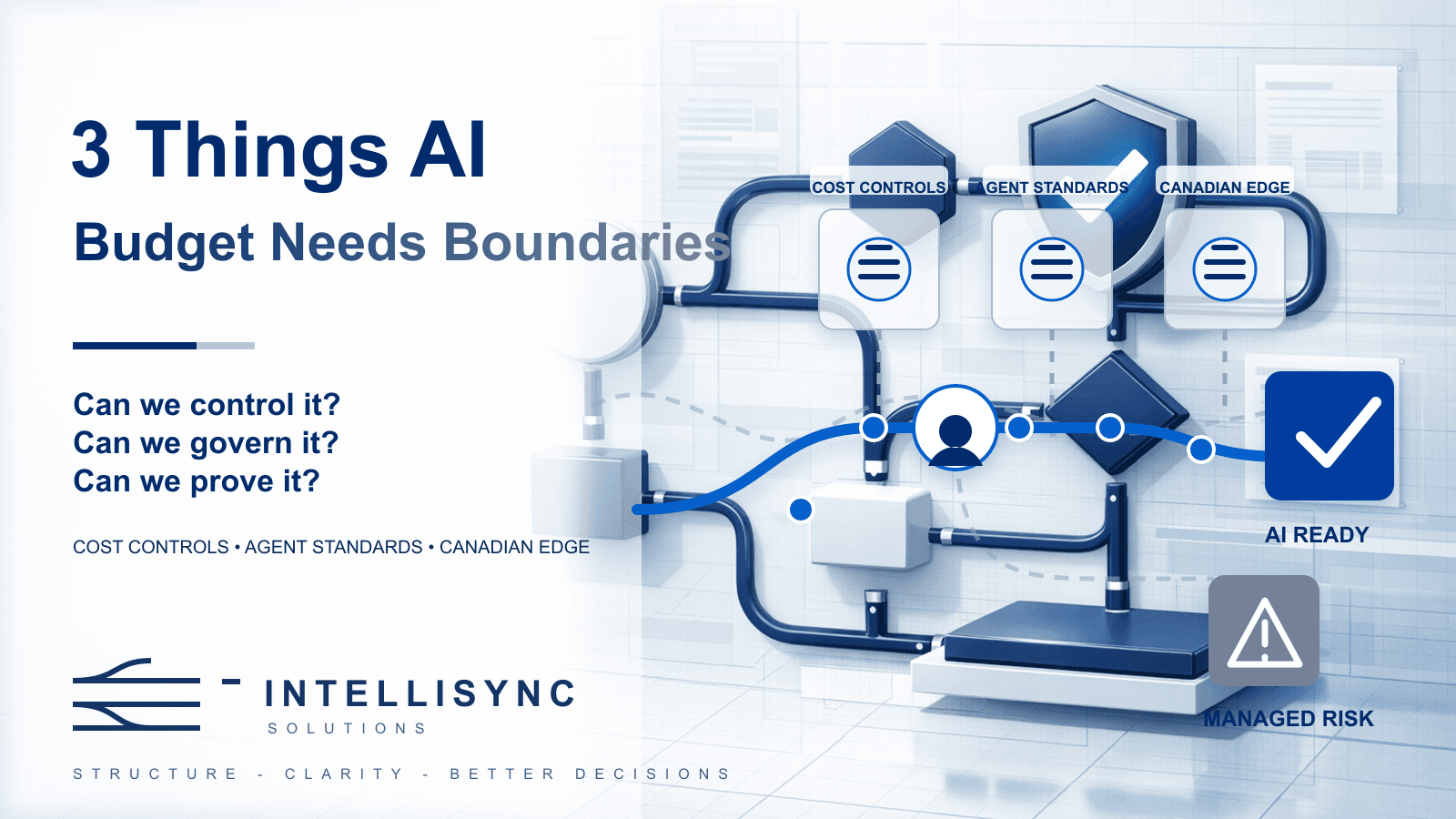
3 Things AI: The "Budget Needs Boundaries" Edition

Three current AI signals translated into practical operating consequences for SMEs, Canadian business leaders, and AI-native operators.

Ai Operating ModelsDecision Architecture
3 Things AI: The "Budget Needs Boundaries" Edition

Article information

July 18, 20265 min read
Published: July 18, 2026
By Chris June
Founder of IntelliSync. Fact-checked against primary sources and Canadian context. Written to structure thinking, not chase hype.
Research metrics
3 sources, 4 backlinks

Compressed answer

Retrieval-ready summary

Direct answer

3 Things AI turns three daily AI signals into practical consequences for cost, governance, visibility, and adoption.

For SMEs, onboard the cloud provider’s cost-investigation feature into your FinOps workflow, tag AI workloads, and configure anomaly alerts and investigation playbooks before scaling agentic or large-model usage. SMEs should inventory any agentic automation, require authenticated agent identities, enable audit logging, and adopt NIST guidance as a baseline for procurement and supplier contracts. Canadian SMEs deploying edge AI should map data flows to edge nodes, enforce device identity and encryption, apply the Cyber Centre’s checklist, and include these controls in procurement and vendor SLAs.

TL;DR

  • For SMEs, onboard the cloud provider’s cost-investigation feature into your FinOps workflow, tag AI workloads, and configure anomaly alerts and investigation playbooks before scaling agentic or large-model usage.
  • SMEs should inventory any agentic automation, require authenticated agent identities, enable audit logging, and adopt NIST guidance as a baseline for procurement and supplier contracts.
  • Canadian SMEs deploying edge AI should map data flows to edge nodes, enforce device identity and encryption, apply the Cyber Centre’s checklist, and include these controls in procurement and vendor SLAs.

Questions answer engines can cite

Why does this signal matter for SMEs?Click to explore

Because it shows where AI is starting to change cost, control, trust, or operational execution.

What is the first practical move?Click to explore

For SMEs, onboard the cloud provider’s cost-investigation feature into your FinOps workflow, tag AI workloads, and configure anomaly alerts and investigation playbooks before scaling agentic or large-model usage.

What risk should leaders watch?Click to explore

The main risk is treating adoption as a software purchase instead of a governed workflow change.

Definitions

AI operating architecture
The structure that connects workflows, context, permissions, measurement, and human ownership.
Control layer
The cost, access, logging, approval, and evidence boundaries around AI use.

Citations

  • AWS announced AI-powered cost investigation in AWS Cost Anomaly Detection and the AWS FinOps Agent that uses Amazon Q to analyze root causes and surface optimization recommendations. Introducing AI-Powered Cost Investigations For Cost Anomalies (AWS Cloud Financial Management blog)
  • NIST announced the AI Agent Standards Initiative to advance research into agent authentication, identity, and interoperability and to publish related guidelines and deliverables. Announcing the AI Agent Standards Initiative for Interoperable and Secure Innovation (NIST)
  • The Canadian Centre for Cyber Security published ITSP.80.101, effective July 15, 2026, providing guidance for secure deployment of AI at the network edge including protections for models, data, and edge-specific mitigations. Securely deploying AI at the network edge (ITSP.80.101)

Decision framework

  1. 1. Stop surprise AI bills: use AI to find the root cause: For SMEs, onboard the cloud provider’s cost-investigation feature into your FinOps workflow, tag AI workloads, and configure anomaly alerts and investigation playbooks before scaling agentic or large-model usage.
  2. 2. If you run AI agents, plan for identity and runtime rules: SMEs should inventory any agentic automation, require authenticated agent identities, enable audit logging, and adopt NIST guidance as a baseline for procurement and supplier contracts.
  3. 3. Edge AI in Canada? follow these mandatory security steps: Canadian SMEs deploying edge AI should map data flows to edge nodes, enforce device identity and encryption, apply the Cyber Centre’s checklist, and include these controls in procurement and vendor SLAs.

Key comparisons

Adoption vs impact

Adoption measures usage; impact measures whether work becomes better, clearer, or better governed.

On this page

12 sections

  1. Short answer
  2. Decision architecture frame
  3. Operating scenario
  4. Implementation checklist
  5. Failure modes and review
  6. AEO FAQ
  7. Why track three AI signals every day?
  8. How should an SME use this format?
  9. What makes an AI post useful for business leaders?
  10. GEO entity map
  11. Internal authority path
  12. Architecture Assessment CTA

3 Things AI: The "Budget Needs Boundaries" Edition

AI is moving from experiment to operating layer.

That means the useful question is no longer:

Can we use AI?

It is:

Can we control the cost? Can we govern the agent? Can we prove the value?

Here are 3 things worth watching.


**

  1. "Stop surprise AI bills: use AI to find the root cause"**

AWS has added AI-powered cost investigation into its Cost Anomaly Detection and the AWS FinOps Agent, using Amazon Q to analyze root causes of detected cost anomalies and surface optimization recommendations (public preview announced June 2026).

Recent source signal: AWS announced AI-powered cost investigation in AWS Cost Anomaly Detection and the AWS FinOps Agent that uses Amazon Q to analyze root causes and surface optimization recommendations. (Introducing AI-Powered Cost Investigations For Cost Anomalies (AWS Cloud Financial Management blog)↗).

IntelliSync perspective: Architecture-first firms should treat cost instrumentation as telemetry: instrument model calls, token counts, and agent tool use into a central cost signal that feeds automated anomaly detection plus policy-driven caps.

Practical takeaway: For SMEs, onboard the cloud provider’s cost-investigation feature into your FinOps workflow, tag AI workloads, and configure anomaly alerts and investigation playbooks before scaling agentic or large-model usage.


**

  1. "If you run AI agents, plan for identity and runtime rules"**

NIST launched the AI Agent Standards Initiative in February 2026 to research and develop standards for agent interoperability, authentication/identity, and security, and to publish guidelines and deliverables addressing agent-specific risks.

Recent source signal: NIST announced the AI Agent Standards Initiative to advance research into agent authentication, identity, and interoperability and to publish related guidelines and deliverables. (Announcing the AI Agent Standards Initiative for Interoperable and Secure Innovation (NIST)↗).

IntelliSync perspective: Treat agents as first-class runtime components: add agent identity, attestation, and auditable control paths into your architecture diagrams and CI/CD pipelines so operational controls can be automated and audited.

Practical takeaway: SMEs should inventory any agentic automation, require authenticated agent identities, enable audit logging, and adopt NIST guidance as a baseline for procurement and supplier contracts.


**

  1. "Edge AI in Canada? follow these mandatory security steps"**

The Canadian Centre for Cyber Security published ITSP.80.101, 'Securely deploying AI at the network edge', which took effect July 15, 2026 and provides operational guidance and controls for deploying AI workloads, including protection of models, data, and edge-specific risk mitigations.

Recent source signal: The Canadian Centre for Cyber Security published ITSP.80.101, effective July 15, 2026, providing guidance for secure deployment of AI at the network edge including protections for models, data, and edge-specific mitigations. (Securely deploying AI at the network edge (ITSP.80.101)↗).

IntelliSync perspective: For architecture teams, edge deployments require hardened device identity, secure model storage, encrypted telemetry, and a centralized patching/monitoring plane integrated with your cloud control layer to maintain a single operational posture.

Practical takeaway: Canadian SMEs deploying edge AI should map data flows to edge nodes, enforce device identity and encryption, apply the Cyber Centre’s checklist, and include these controls in procurement and vendor SLAs.


The bigger pattern:

Cloud cost controls, agent governance standards, and Canadian edge security guidance together show the conversation shifting from experimentation to operational controls: cost governance, identity and runtime controls for agents, and sector-specific security guidance are now the measurable entry points for SMEs and Canadian leaders.

For businesses planning their first or next AI move, IntelliSync has 18 free downloadable AI-Native PDF templates covering readiness, implementation, risk, policy, vendor evaluation, ROI, skills, and roadmap planning.

Download them here: https://www.intellisync.io/en/ai-native-templates↗

Learn more about IntelliSync: https://www.intellisync.io/en/↗

Short answer

3 Things AI tracks daily professional AI signals and translates them into operational consequences: cost, governance, proof, visibility, and measurable adoption.

Decision architecture frame

The common thread is not AI novelty. It is architecture: which controls need to exist before AI touches workflows, customers, data, or decisions?

Operating scenario

A Canadian SME can use these three signals as a daily review loop: which decision changes, which owner is affected, which evidence is missing, which risk needs control, and which metric proves value.

Implementation checklist

  • Pick one workflow or decision touched by the signal.
  • Identify the data, tool, owner, and review threshold.
  • Define what AI can read, recommend, draft, or execute.
  • Add logs, limits, approvals, and ROI measurement before scale.
  • Verify the website, policy, and operating process tell the same story.

Failure modes and review

thresholds

Watch for signals moving faster than the operating model: spend without ceilings, agents without permissions, content without proof, adoption without metrics, or automation without a named human owner.

AEO FAQ

Why track three AI signals every day?

Because AI trends only become commercially useful when they change a decision, cost, risk, workflow, or operating capability.

How should an SME use this format?

Pick one signal, map the affected workflow, name the owner, then define the data, risk threshold, and success metric before adding more automation.

What makes an AI post useful for business leaders?

It connects a sourced fact to a clear operating consequence instead of only commenting on the technology.

GEO entity map

  • IntelliSync Solutions
  • AI-native operating architecture
  • decision architecture
  • agent orchestration
  • AI governance
  • Canadian SMEs
  • AI search visibility
  • operational intelligence mapping

Internal authority path

  • AI-Native Templates↗
  • Practical readiness, risk, policy, ROI, vendor, and roadmap planning tools.
  • IntelliSync Solutions↗
  • Architecture-first AI operating model guidance for Canadian SMEs.
  • Open Architecture Assessment
  • Turns the post into a concrete next step for operating-model review.
  • View Operating Architecture
  • Connects the daily signals to IntelliSync's architecture layer.

Architecture Assessment CTA

Start with an Architecture Assessment if your daily AI signals are starting to touch cost, agents, visibility, governance, or customer-facing workflows.
Reference layer

Sources and internal context

3 sources / 4 backlinks

Sources
↗Introducing AI-Powered Cost Investigations For Cost Anomalies (AWS Cloud Financial Management blog)
↗Announcing the AI Agent Standards Initiative for Interoperable and Secure Innovation (NIST)
↗Securely deploying AI at the network edge (ITSP.80.101)
Related Links
↗AI-Native Templates
↗IntelliSync Solutions
↗Open Architecture Assessment
↗View Operating Architecture

Architecture path

Where to go next in IntelliSync

These internal pages extend the article into the next architecture decision, operating model, or implementation step.

1
AI-Native Templates

Practical readiness, risk, policy, ROI, vendor, and roadmap planning tools.

2
IntelliSync Solutions

Architecture-first AI operating model guidance for Canadian SMEs.

3
Open Architecture Assessment

Turns the post into a concrete next step for operating-model review.

4
View Operating Architecture

Connects the daily signals to IntelliSync's architecture layer.

Best next step

Editorial by: Chris June

Chris June leads IntelliSync’s operational-first editorial research on clear decisions, clear context, coordinated handoffs, and Canadian oversight.

Open Architecture AssessmentView Operating ArchitectureBrowse Patterns
Follow us:

For more news and AI-Native insights, follow us on social media.

If this sounds familiar in your business

You don't have an AI problem. You have a thinking-structure problem.

In one session we map where the thinking breaks — decisions, context, ownership — and show you the safest first move before anything gets automated.

Open Architecture AssessmentView Operating Architecture

Adjacent reading

Related Posts

3 Things AI: The "Useful AI Needs Controls" Edition
Ai Operating ModelsDecision Architecture
3 Things AI: The "Useful AI Needs Controls" Edition
Three current AI signals translated into practical operating consequences for SMEs, Canadian business leaders, and AI-native operators.
Jul 16, 2026
Read brief
3 Things AI: The "Your AI Budget Needs a Seatbelt" Edition
Ai Operating ModelsDecision Architecture
3 Things AI: The "Your AI Budget Needs a Seatbelt" Edition
Three current AI signals translated into practical operating consequences for SMEs, Canadian business leaders, and AI-native operators.
Jul 14, 2026
Read brief
3 Things AI: The "Search Needs Proof" Edition
Ai Operating ModelsDecision Architecture
3 Things AI: The "Search Needs Proof" Edition
Three current AI signals translated into practical operating consequences for SMEs, Canadian business leaders, and AI-native operators.
Jul 11, 2026
Read brief
IntelliSync Solutions
IntelliSyncArchitecture_Group

Structure. Clarity. Better Decisions.

Location: Chatham-Kent, ON.

Email:info@intellisync.ca

Services
  • >>Services
  • >>Results
  • >>Architecture Assessment
  • >>Industries
  • >>Canadian Governance
Company
  • >>About
  • >>Blog
Depth & Resources
  • >>AI-Native Templates
  • >>Operating Architecture
  • >>Decision Architecture
  • >>MCP Architecture
  • >>Agentic Systems
  • >>Maturity
  • >>Patterns
Legal
  • >>FAQ
  • >>Privacy Policy
  • >>Terms of Service