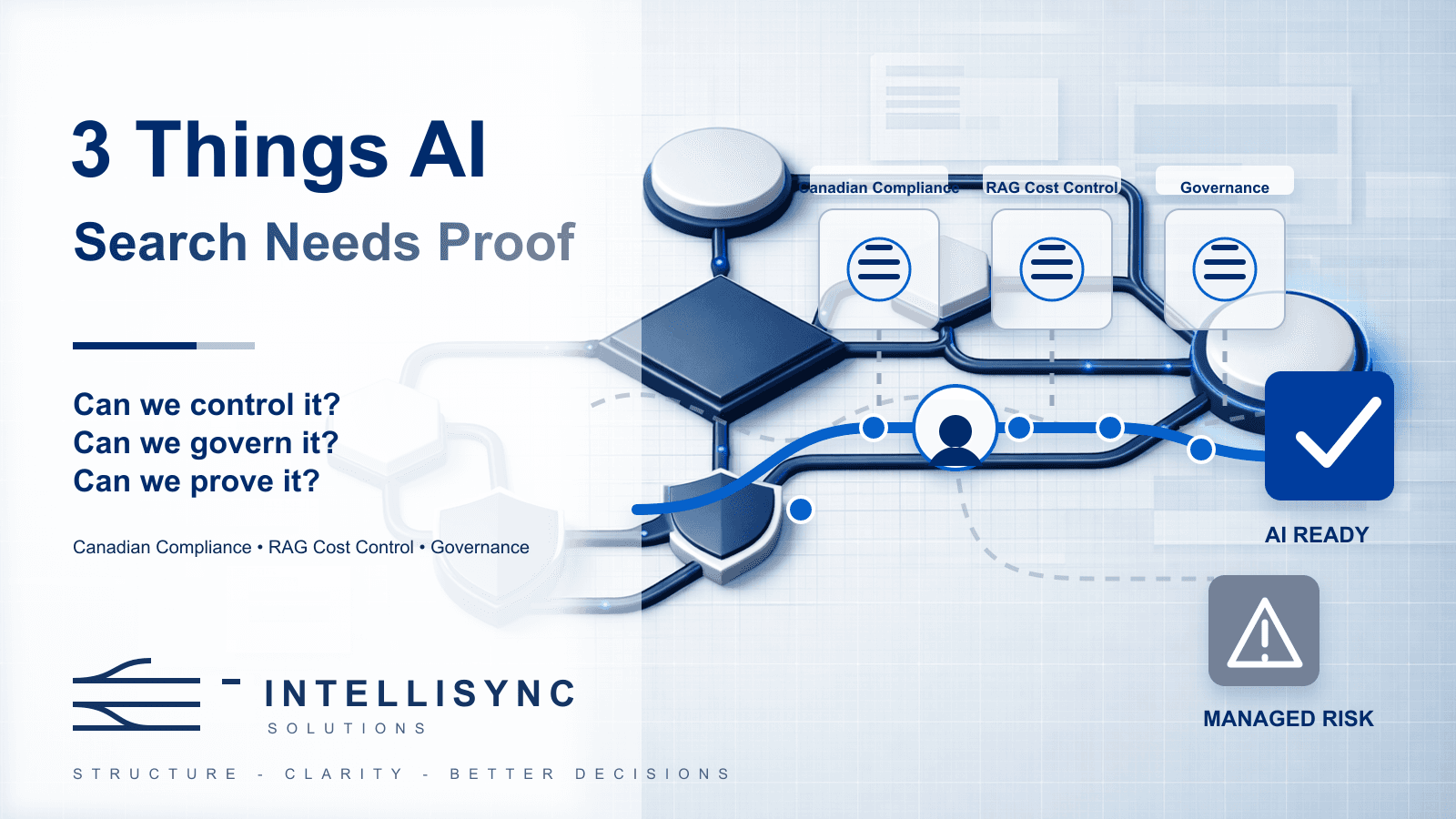
3 Things AI: The "Search Needs Proof" Edition
AI is moving from experiment to operating layer.
That means the useful question is no longer:
Can we use AI?
It is:
Can we control the cost? Can we govern the agent? Can we prove the value?
Here are 3 things worth watching.
**
- "What Canadian leaders must file — and why SMEs can’t ignore it"**
The Government of Canada’s Directive on Automated Decision-Making and companion guidance (Guide on the Scope of the Directive; Responsible Use pages) set expectations for risk assessments, algorithmic impact assessments, data security and transparency for automated decision systems used in or by federal departments. While the Directive directly binds federal departments, the Guide and related public guidance clarify transparency and risk controls that private-sector suppliers and vendors should expect when contracting with government and inform best-practice expectations for Canadian businesses. These documents also point to specific operational controls (risk assessments, data/model integrity measures, publication of certain algorithmic information for eligible systems).
Recent source signal: Directive requires risk assessments, information-management and model-integrity measures during development and maintenance of automated decision systems; Guide published June 24, 2024 clarifies scope and expectations for implementation. (tbs-sct.canada.ca) (Directive on Automated Decision-Making; Guide on the Scope of the Directive; Responsible use of AI in government).
IntelliSync perspective: Architect for compliance: treat the Directive’s assessment and documentation steps as required design checkpoints in your solution lifecycle (ingest → vectorization → retrieval → model inference → human review). Map each stage to a control owner, required evidence artifact (risk assessment, test logs, AI impact summary), and an access/retention policy so procurement and legal teams can rely on consistent artifacts.
Practical takeaway: SMEs selling to, partnering with, or operating in the Canadian public sector should bake Algorithmic Impact Assessment and data-integrity controls into product roadmaps now; even private-sector buyers should demand the same artifacts to reduce procurement risk and speed contracting.
**
- "Your vector DB could be 40% of the bill — how to stop the surprise"**
Public materials from major vector providers and cloud vendors show vector storage and access patterns are a material cost driver in RAG systems. Vendor docs and recent operator guides highlight cost levers: embedding frequency, vector dimensionality and compression, index configuration, write/upsert batching, TTL/lifecycle policies, and hybrid search strategies (metadata + sparse + vectors). Reports from vector vendors and operator blogs estimate vector storage/querying can represent a large share of application cost (examples from Milvus operator guidance and Pinecone pricing/docs), while cloud reference architectures (Google Cloud Vertex AI RAG guidance) provide explicit optimization recommendations for production deployments.
Recent source signal: Operator guidance and vendor pricing show vector DBs can account for a significant portion of RAG application costs and provide concrete levers (WU/pricing models, batching, TTLs, index configuration) to reduce bills. (pinecone.io) (Pinecone pricing and cost docs; Milvus cost-optimization guide; Google Cloud RAG/Vertex AI reference architecture and best-practices blog).
IntelliSync perspective: Architect for cost predictability: instrument per-stage metering (ingest, embedding, vector writes, vector queries, LLM inference), enforce quotas and batch policies at the ingestion layer, and choose index configs for your SLA (approximate indexes for high-QPS; denser/filtered indexes for accuracy when latency is lower priority). Automate lifecycle (expire stale vectors) and add a governance control that forces cost review before new data sources are onboarded.
Practical takeaway: Before scaling RAG, run a 30-day billing simulation: measure request patterns, cap embedding calls, enable index compression/quantization, and set vector TTLs — expect vector infra and LLM API calls to be the dominant cost buckets. Use vendor calculators and the cloud RAG reference architecture to validate budgets.
**
- "A lightweight governance playbook for agentic AI and SMEs"**
NIST’s AI Risk Management Framework (AI RMF), the Generative AI Profile, and the RMF Small Enterprise Quick Start Guide provide practical, RMF-aligned checklists and maturity-focused steps for smaller organisations. The Quick Start focuses on simplified inventory, threat/risk scoping, prioritized controls, and measurement practices designed to be feasible for SMEs. The Generative AI Profile highlights evaluation and monitoring for generative models. Together, these materials give an actionable baseline for governance and operational controls that map directly to architecture and runbook tasks (model selection, testing, telemetry, incident playbooks).
Recent source signal: NIST released a Small Enterprise Quick Start Guide (July 24, 2024) and a Generative AI Profile (July 26, 2024) to help smaller organisations apply the AI RMF with prioritized, feasible controls and measurement practices. (nist.gov) (NIST AI Risk Management Framework; NIST RMF Small Enterprise Quick Start Guide; NIST Generative AI Profile announcement).
IntelliSync perspective: Start with an ‘RMF-lite’ implementation: minimal inventory of AI assets, prioritized risk scenarios for core business processes, simple test harnesses for hallucination/accuracy, and automated telemetry that feeds a weekly risk dashboard. For agentic or orchestration layers, require traceability (decision logs) and human-in-the-loop gates by default.
Practical takeaway: SMEs can operationalize governance without heavyweight programs: use NIST’s Small Enterprise Quick Start to produce a prioritized 90‑day plan (inventory → top-3 risk scenarios → tests → telemetry), then iterate. Treat governance artifacts as living architecture contracts.
The bigger pattern:
AI adoption for SMEs is shifting from experimentation to disciplined operationalization: measurable cost control (especially for RAG/vector layers), explicit governance for agentic/automated decision systems, and alignment with national regulator expectations are the drivers separating value capture from hidden risk.
For businesses planning their first or next AI move, IntelliSync has 18 free downloadable AI-Native PDF templates covering readiness, implementation, risk, policy, vendor evaluation, ROI, skills, and roadmap planning.
Download them here: https://www.intellisync.io/en/ai-native-templates
Learn more about IntelliSync: https://www.intellisync.io/en/
Short answer
3 Things AI tracks daily professional AI signals and translates them into operational consequences: cost, governance, proof, visibility, and measurable adoption.
Decision architecture frame
The common thread is not AI novelty. It is architecture: which controls need to exist before AI touches workflows, customers, data, or decisions?
Operating scenario
A Canadian SME can use these three signals as a daily review loop: which decision changes, which owner is affected, which evidence is missing, which risk needs control, and which metric proves value.
Implementation checklist
- Pick one workflow or decision touched by the signal.
- Identify the data, tool, owner, and review threshold.
- Define what AI can read, recommend, draft, or execute.
- Add logs, limits, approvals, and ROI measurement before scale.
- Verify the website, policy, and operating process tell the same story.
Failure modes and review
thresholds
Watch for signals moving faster than the operating model: spend without ceilings, agents without permissions, content without proof, adoption without metrics, or automation without a named human owner.
AEO FAQ
Why track three AI signals every day?
Because AI trends only become commercially useful when they change a decision, cost, risk, workflow, or operating capability.
How should an SME use this format?
Pick one signal, map the affected workflow, name the owner, then define the data, risk threshold, and success metric before adding more automation.
What makes an AI post useful for business leaders?
It connects a sourced fact to a clear operating consequence instead of only commenting on the technology.
GEO entity map
- IntelliSync Solutions
- AI-native operating architecture
- decision architecture
- agent orchestration
- AI governance
- Canadian SMEs
- AI search visibility
- operational intelligence mapping
Internal authority path
- AI-Native Templates
- Practical readiness, risk, policy, ROI, vendor, and roadmap planning tools.
- IntelliSync Solutions
- Architecture-first AI operating model guidance for Canadian SMEs.
- Open Architecture Assessment
- Turns the post into a concrete next step for operating-model review.
- View Operating Architecture
- Connects the daily signals to IntelliSync's architecture layer.
Architecture Assessment CTA
Start with an Architecture Assessment if your daily AI signals are starting to touch cost, agents, visibility, governance, or customer-facing workflows.