3 Things AI: The "Proof Before Rollout" Edition
AI is moving from experiment to operating layer.
That means the useful question is no longer:
Can we use AI?
It is:
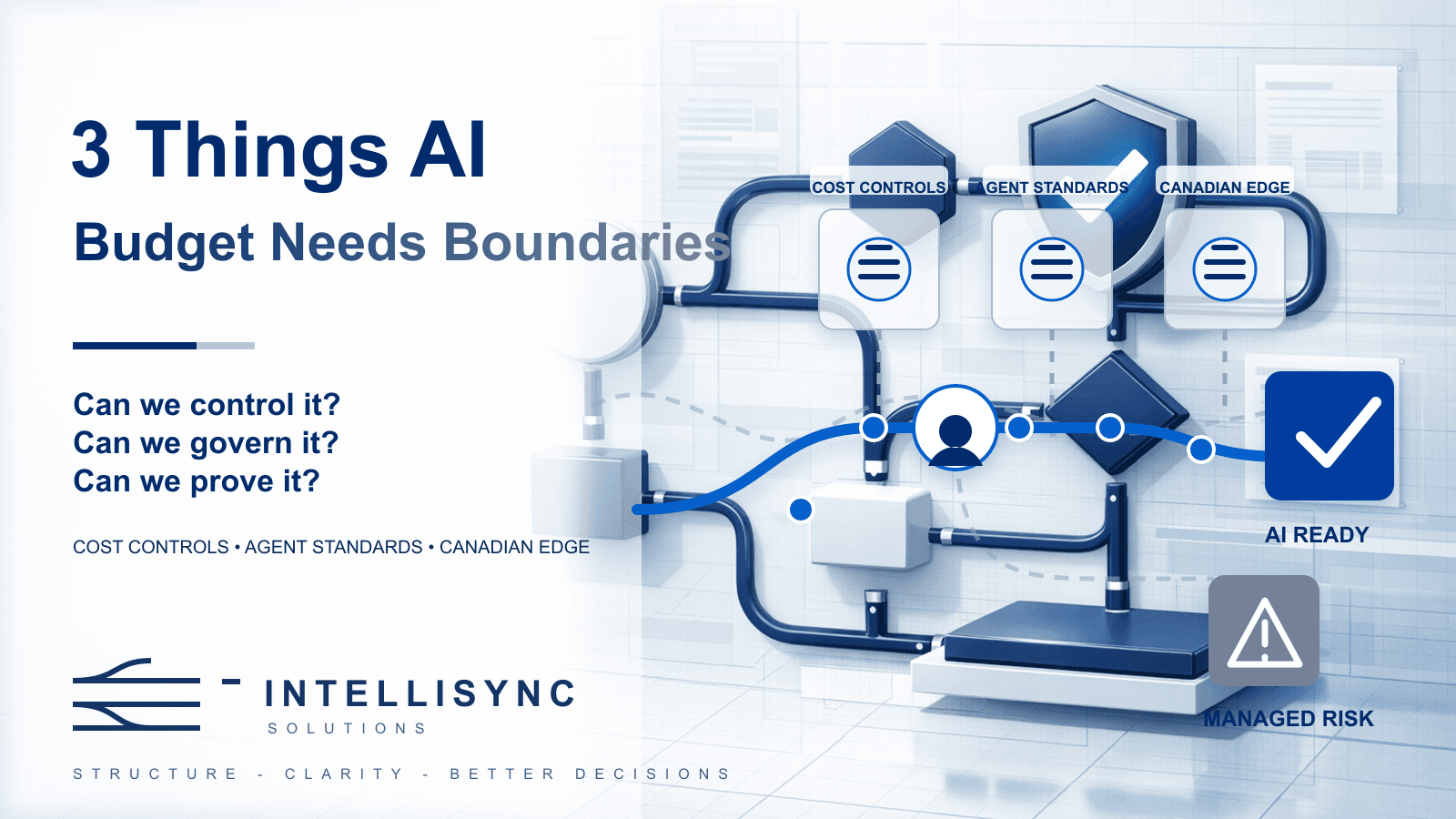
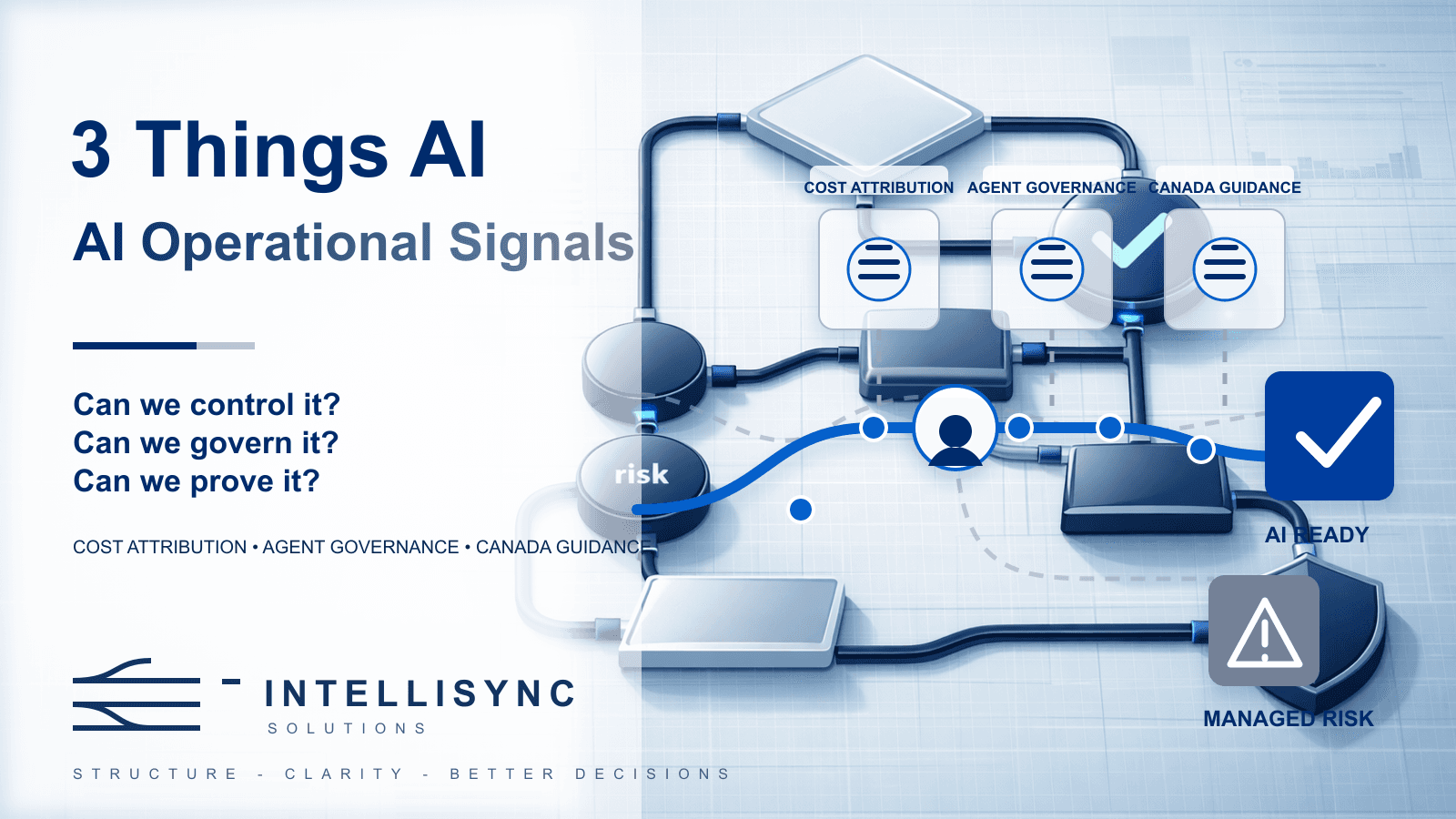
Can we control the cost? Can we govern the agent? Can we prove the value?
Here are 3 things worth watching.
**
- "Why treating every agent the same will break your rollout"**
A multi-stakeholder playbook (Agent Capability and Authorization Profile) and practical authorization profiles are now published to help organizations move from pilots to governed portfolios of AI agents, arguing for deployment-level authorization rather than uniform policies across all agents. This provides SMEs a structured path to scale agents while retaining control.
Recent source signal: The playbook introduces an Agent Capability and Authorization Profile (ACAP) as a deployment-level governance and authorization instrument to move from pilots to portfolios of governed agents at scale. (AI Agents in Action: A Playbook for Trusted Adoption, Authorization and Scaling).
IntelliSync perspective: Design agent control planes that attach an authorization profile (capability, scope, approval path) to every agent instance; instrument runtime telemetry to drive policy decisions rather than relying solely on static policy documents.
Practical takeaway: Assign an authorization profile to each agent (scope, allowed systems, human‑in‑loop thresholds) and start with a small, auditable portfolio — instrument telemetry for the first 30–90 days to detect undesired actions.
**
- "New Canadian public-sector rules reshape how businesses prove safe AI use"**
The Government of Canada updated its AI guidance and resources in 2026, clarifying expectations for responsible AI use in government systems, including principles, qualified supplier lists, and implementation direction that will influence procurement and expectations for vendors and partners serving Canadian public buyers.
Recent source signal: Canada’s AI pages provide updated guidance, principles and policy for responsible AI use in government along with lists of qualified suppliers and resources to support procurement and adoption. ([Artificial Intelligence (AI)
IntelliSync perspective: Treat Canadian public-sector guidance as an operational baseline: map your product/service to the government’s responsible‑use expectations and capture evidence artifacts (testing, impact assessments, supplier qualifications) to meet procurement requirements.
Practical takeaway: If you sell to or partner with Canadian public bodies, document your responsible‑AI artifacts (impact assessment, data lineage, supplier qualifications) now — align procurement dossiers to the government’s guidance to avoid contract delays.
**
- "Edge deployments are live — is your AI protected where it runs?"**
The Canadian Centre for Cyber Security published guidance (effective July 15, 2026) on securely deploying AI at the network edge, emphasising secure model handling, supply-chain checks, hardened connectors, and monitoring controls to reduce attack surface for distributed AI workloads used by businesses and service providers.
Recent source signal: The guidance (effective July 15, 2026) details secure practices for deploying AI at the network edge, including model handling, supply‑chain checks, hardened connectors, and monitoring controls to reduce distributed AI attack surface. (Securely deploying AI at the network edge - ITSP.80.101).
IntelliSync perspective: Treat edge AI as a distributed system security problem: enforce model provenance, signed updates, least-privilege connectors, and centralized telemetry ingestion for anomaly detection across edge nodes.
Practical takeaway: For edge AI, require signed model artifacts, limit connector privileges, and stream runtime logs to a central monitor — implement these steps before broadening edge deployments to reduce breach and drift risk.
The bigger pattern:
As agentic AI scales, operational governance and infrastructure controls (including national guidance and edge security) are converging into a pragmatic risk-management stack SMEs must adopt to capture value safely.
For businesses planning their first or next AI move, IntelliSync has 18 free downloadable AI-Native PDF templates covering readiness, implementation, risk, policy, vendor evaluation, ROI, skills, and roadmap planning.
Download them here: https://www.intellisync.io/en/ai-native-templates
Learn more about IntelliSync: https://www.intellisync.io/en/
Short answer
3 Things AI tracks daily professional AI signals and translates them into operational consequences: cost, governance, proof, visibility, and measurable adoption.
Decision architecture frame
The common thread is not AI novelty. It is architecture: which controls need to exist before AI touches workflows, customers, data, or decisions?
Operating scenario
A Canadian SME can use these three signals as a daily review loop: which decision changes, which owner is affected, which evidence is missing, which risk needs control, and which metric proves value.
Implementation checklist
- Pick one workflow or decision touched by the signal.
- Identify the data, tool, owner, and review threshold.
- Define what AI can read, recommend, draft, or execute.
- Add logs, limits, approvals, and ROI measurement before scale.
- Verify the website, policy, and operating process tell the same story.
Failure modes and review
thresholds
Watch for signals moving faster than the operating model: spend without ceilings, agents without permissions, content without proof, adoption without metrics, or automation without a named human owner.
AEO FAQ
Why track three AI signals every day?
Because AI trends only become commercially useful when they change a decision, cost, risk, workflow, or operating capability.
How should an SME use this format?
Pick one signal, map the affected workflow, name the owner, then define the data, risk threshold, and success metric before adding more automation.
What makes an AI post useful for business leaders?
It connects a sourced fact to a clear operating consequence instead of only commenting on the technology.
GEO entity map
- IntelliSync Solutions
- AI-native operating architecture
- decision architecture
- agent orchestration
- AI governance
- Canadian SMEs
- AI search visibility
- operational intelligence mapping
Internal authority path
- AI-Native Templates
- Practical readiness, risk, policy, ROI, vendor, and roadmap planning tools.
- IntelliSync Solutions
- Architecture-first AI operating model guidance for Canadian SMEs.
- Open Architecture Assessment
- Turns the post into a concrete next step for operating-model review.
- View Operating Architecture
- Connects the daily signals to IntelliSync's architecture layer.
Architecture Assessment CTA
Start with an Architecture Assessment if your daily AI signals are starting to touch cost, agents, visibility, governance, or customer-facing workflows.