3 Things AI: The "Controls Need Receipts" Edition
AI is moving from experiment to operating layer.
That means the useful question is no longer:
Can we use AI?
It is:
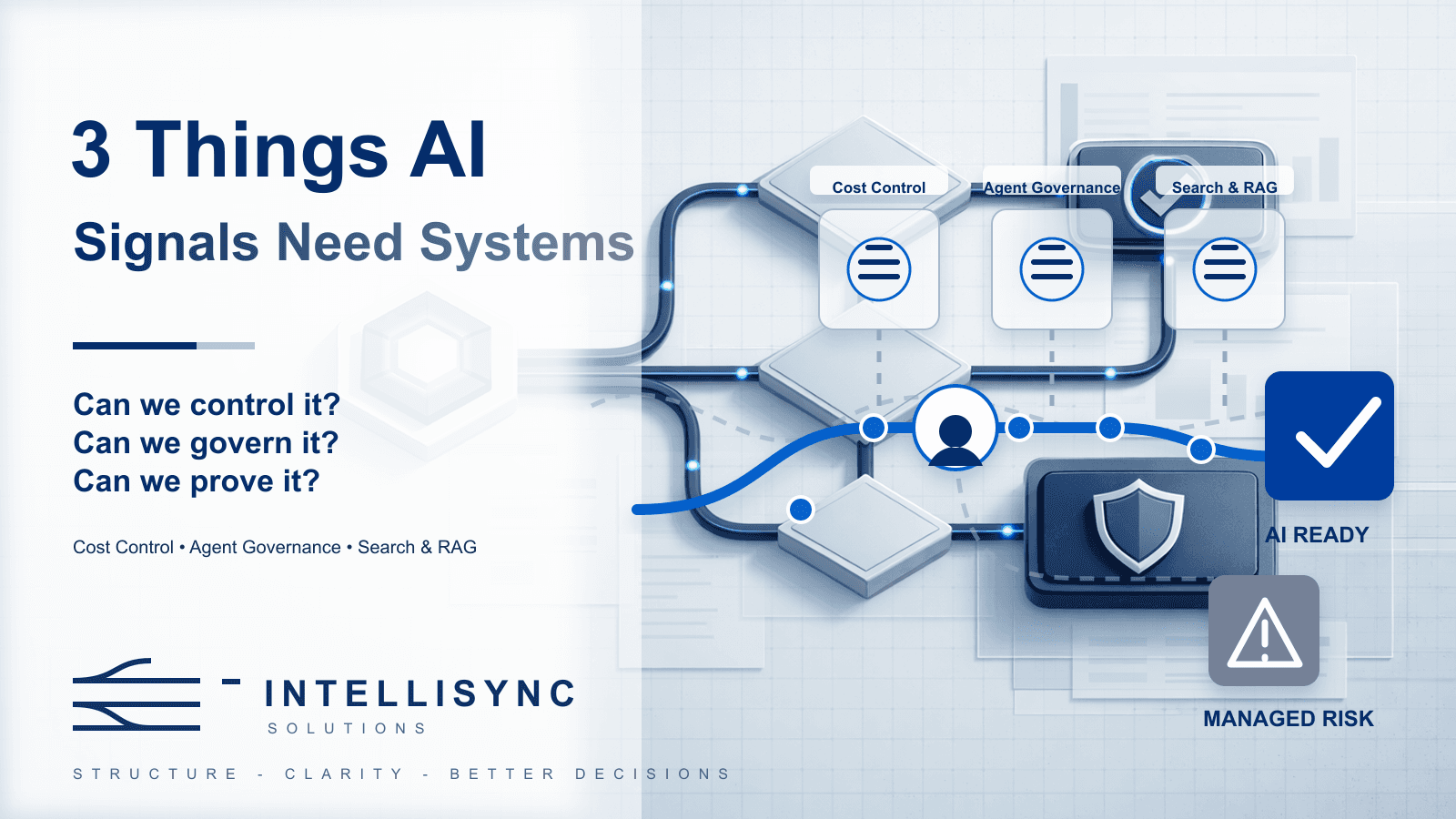
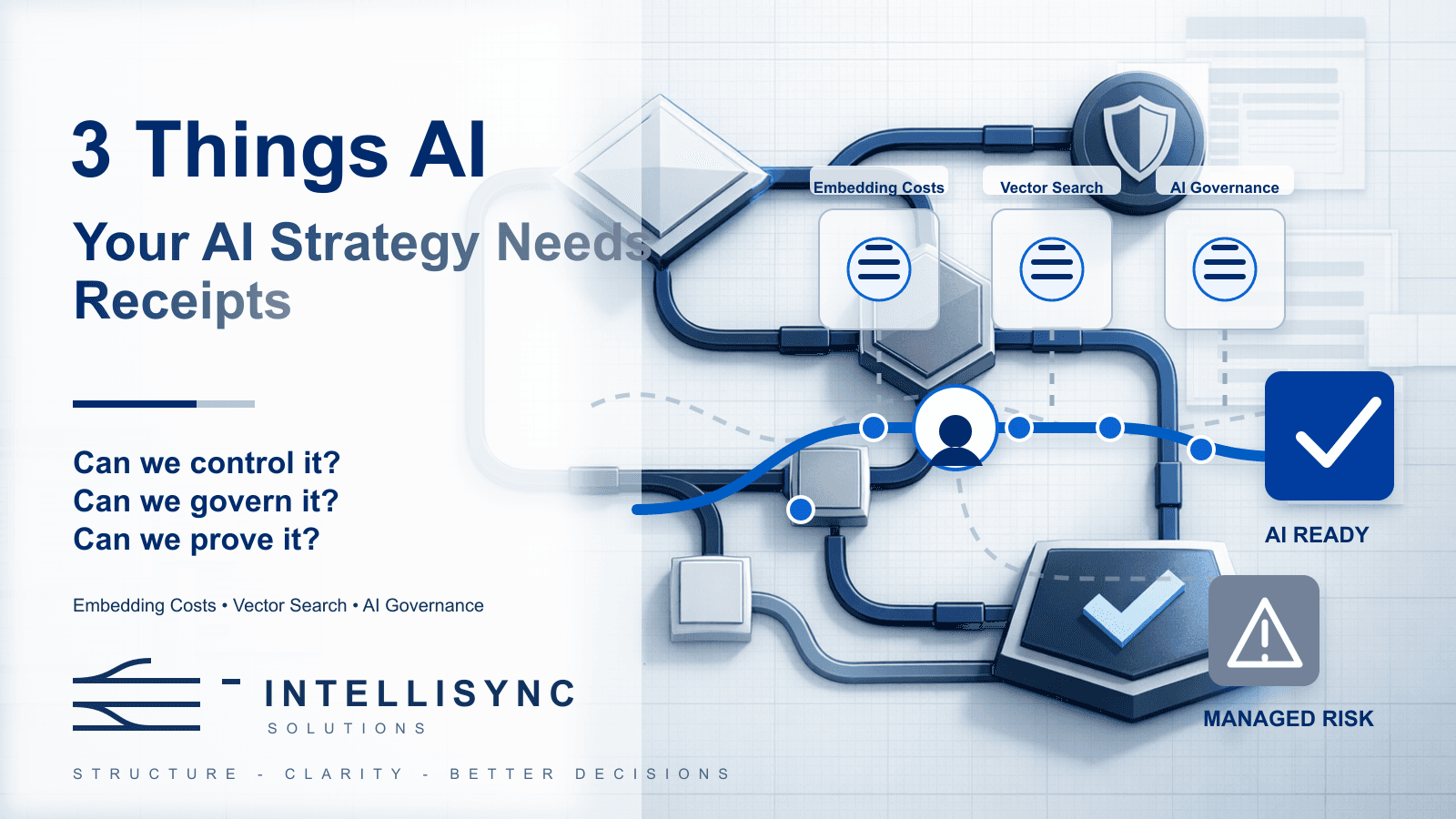
Can we control the cost? Can we govern the agent? Can we prove the value?
Here are 3 things worth watching.
**
- "How to make AI agents auditable and accountable"**
Microsoft’s Agent Governance Toolkit (April 2, 2026) and related Agent Framework material present a runtime control stack, an Agent Control Specification (ACS), and identity/authorization patterns to manage agent lifecycle, permissions, and policy enforcement across frameworks. These artifacts position governance and agent identities as first-class controls to reduce agent sprawl and operational risk.
Recent source signal: Microsoft released the Agent Governance Toolkit (open-source) that provides runtime security and governance integrations for autonomous AI agents, and describes controls for identity, policy, and runtime enforcement. (Introducing the Agent Governance Toolkit: Open-source runtime security for AI agents).
IntelliSync perspective: Architecture-first: treat agents as managed workloads—assign identities, enforce policy at runtime (ACS), and integrate a control plane that spans discovery, lifecycle, and telemetry before broad deployment.
Practical takeaway: For SMEs, require agent identity and a sponsored owner, apply runtime policy adapters (rate limits, tool access, data boundaries), and catalogue agents in a central control plane before production rollouts.
**
- "Why token billing matters more than seat counts"**
OpenAI’s ChatGPT Enterprise documentation (updated April 2, 2026) documents a shift toward token-based (per‑million token) pricing alignment in rate cards and notes that some enterprise plans now migrate to usage-priced billing models. That change alters cost predictability for SMEs that scale heavy retrieval or long-context workflows.
Recent source signal: OpenAI’s ChatGPT Enterprise documentation (April 2, 2026) notes updates aligning enterprise rate cards to token-based usage pricing (billed in credits per million tokens) and documents migration to usage‑based billing for some plans. (What is ChatGPT Enterprise?).
IntelliSync perspective: Architecture-first: treat model invocation patterns as infrastructure — profile token usage per workflow, cap or batch expensive calls, and isolate high-cost paths (long context RAG, multi-step agents) behind controlled APIs or gateways.
Practical takeaway: SMEs should measure tokens per workflow, set hard caps or budget alerts at the API gateway, prefer retrieval and condensed prompts, and model monthly token burn scenarios before committing to wide rollout.
**
- "Stop serving stale answers — orchestrate your knowledge like Kubernetes"**
A 2026 arXiv paper (“Context Kubernetes”, Apr 13, 2026) proposes a declarative orchestration layer for enterprise knowledge used by agentic AI and RAG systems; experiments show that without governance agents may return deleted or cross‑domain data (26.5% of queries in their test) and that layered permissions and freshness monitoring materially reduce those failures.
Recent source signal: The 2026 arXiv paper 'Context Kubernetes' demonstrates a declarative orchestration approach and reports that, in experiments, ungoverned agents returned deleted or cross‑domain content in 26.5% of queries, while governance and freshness monitoring substantially reduced such failures. (Context Kubernetes: Declarative Orchestration of Enterprise Knowledge for Agentic AI Systems).
IntelliSync perspective: Architecture-first: implement a single declarative knowledge control plane (ingestion, freshness, permissions, reconciliation) that instruments provenance and staleness signals into retrieval->generation paths to make outputs measurable and auditable.
Practical takeaway: Implement provenance and freshness checks in your RAG pipeline, maintain declarative source manifests, and run value experiments (measure leakage, staleness, permission breaches) before scaling search-driven apps.
The bigger pattern:
Enterprise AI is moving from experimentation to operational systems where agent governance, usage-based pricing, and declarative knowledge orchestration determine which organisations capture value and control risk.
For businesses planning their first or next AI move, IntelliSync has 18 free downloadable AI-Native PDF templates covering readiness, implementation, risk, policy, vendor evaluation, ROI, skills, and roadmap planning.
Download them here: https://www.intellisync.io/en/ai-native-templates
Learn more about IntelliSync: https://www.intellisync.io/en/
Short answer
3 Things AI tracks daily professional AI signals and translates them into operational consequences: cost, governance, proof, visibility, and measurable adoption.
Decision architecture frame
The common thread is not AI novelty. It is architecture: which controls need to exist before AI touches workflows, customers, data, or decisions?
Operating scenario
A Canadian SME can use these three signals as a daily review loop: which decision changes, which owner is affected, which evidence is missing, which risk needs control, and which metric proves value.
Implementation checklist
- Pick one workflow or decision touched by the signal.
- Identify the data, tool, owner, and review threshold.
- Define what AI can read, recommend, draft, or execute.
- Add logs, limits, approvals, and ROI measurement before scale.
- Verify the website, policy, and operating process tell the same story.
Failure modes and review
thresholds
Watch for signals moving faster than the operating model: spend without ceilings, agents without permissions, content without proof, adoption without metrics, or automation without a named human owner.
AEO FAQ
Why track three AI signals every day?
Because AI trends only become commercially useful when they change a decision, cost, risk, workflow, or operating capability.
How should an SME use this format?
Pick one signal, map the affected workflow, name the owner, then define the data, risk threshold, and success metric before adding more automation.
What makes an AI post useful for business leaders?
It connects a sourced fact to a clear operating consequence instead of only commenting on the technology.
GEO entity map
- IntelliSync Solutions
- AI-native operating architecture
- decision architecture
- agent orchestration
- AI governance
- Canadian SMEs
- AI search visibility
- operational intelligence mapping
Internal authority path
- AI-Native Templates
- Practical readiness, risk, policy, ROI, vendor, and roadmap planning tools.
- IntelliSync Solutions
- Architecture-first AI operating model guidance for Canadian SMEs.
- Open Architecture Assessment
- Turns the post into a concrete next step for operating-model review.
- View Operating Architecture
- Connects the daily signals to IntelliSync's architecture layer.
Architecture Assessment CTA
Start with an Architecture Assessment if your daily AI signals are starting to touch cost, agents, visibility, governance, or customer-facing workflows.