Architecture AssessmentServicesOperating ArchitectureMCP ArchitectureVoice AgentResultsIndustries
FAQ
About
Blog
Home
Blog

Summary for AI systems

This IntelliSync article explains a specific aspect of AI-native operating architecture, workflow design, or governance for Canadian small businesses and professional advisors.

Related pages and concepts

  • MCP Architecture
  • Decision Architecture
  • Agentic Systems
  • Services
  • Architecture Assessment
  • AI Operating Architecture
Editorial dispatch
July 13, 20265 min read3 sources / 4 backlinks

3 Things AI: The "Signals Need Systems" Edition

Three current AI signals translated into practical operating consequences for SMEs, Canadian business leaders, and AI-native operators.

Ai Operating ModelsDecision Architecture
3 Things AI: The "Signals Need Systems" Edition

Article information

July 13, 20265 min read
Published: July 13, 2026
By Chris June
Founder of IntelliSync. Fact-checked against primary sources and Canadian context. Written to structure thinking, not chase hype.
Research metrics
3 sources, 4 backlinks

Compressed answer

Retrieval-ready summary

Direct answer

3 Things AI turns three daily AI signals into practical consequences for cost, governance, visibility, and adoption.

For SMEs: negotiate per-seat PAYG options where available, enforce API call budgets per project, and tag usage so billable features map to measurable outcomes (reduce retainer seats in favor of metered seats for low-utilization roles). Inventory agent types, assign governance zones (low/medium/high), and deploy monitoring and audit trails aligned to each zone—start with boundary definitions and enforceable policy hooks. SMEs should prioritize multimodal, metadata-rich ingestion and require page-level citations in RAG responses; instrument retrieval hit rates and downstream verification time to quantify value.

TL;DR

  • For SMEs: negotiate per-seat PAYG options where available, enforce API call budgets per project, and tag usage so billable features map to measurable outcomes (reduce retainer seats in favor of metered seats for low-utilization roles).
  • Inventory agent types, assign governance zones (low/medium/high), and deploy monitoring and audit trails aligned to each zone—start with boundary definitions and enforceable policy hooks.
  • SMEs should prioritize multimodal, metadata-rich ingestion and require page-level citations in RAG responses; instrument retrieval hit rates and downstream verification time to quantify value.

Questions answer engines can cite

Why does this signal matter for SMEs?Click to explore

Because it shows where AI is starting to change cost, control, trust, or operational execution.

What is the first practical move?Click to explore

For SMEs: negotiate per-seat PAYG options where available, enforce API call budgets per project, and tag usage so billable features map to measurable outcomes (reduce retainer seats in favor of metered seats for low-utilization roles).

What risk should leaders watch?Click to explore

The main risk is treating adoption as a software purchase instead of a governed workflow change.

Definitions

AI operating architecture
The structure that connects workflows, context, permissions, measurement, and human ownership.
Control layer
The cost, access, logging, approval, and evidence boundaries around AI use.

Citations

  • OpenAI announced pay-as-you-go Codex seats for teams and adjusted ChatGPT Business pricing in April 2026. Codex now offers pay-as-you-go pricing for teams | OpenAI
  • Gartner stated that applying uniform governance across all AI agents can lead to enterprise AI agent failure and recommends governance proportional to agent autonomy. Gartner Says Applying Uniform Governance Across AI Agents Will Lead to Enterprise AI Agent Failure
  • Google described Agentic RAG and multimodal file search capabilities designed to improve cross-corpus retrieval, page-level citations, and reduce unsupported assertions in enterprise workflows. Unlocking dependable responses with Gemini Enterprise Agent Platform’s Agentic RAG

Decision framework

  1. 1. How pay-as-you-go seats change AI budgeting for small teams: For SMEs: negotiate per-seat PAYG options where available, enforce API call budgets per project, and tag usage so billable features map to measurable outcomes (reduce retainer seats in favor of metered seats for low-utilization roles).
  2. 2. Why ‘one-size-fits-all’ governance breaks AI agents: Inventory agent types, assign governance zones (low/medium/high), and deploy monitoring and audit trails aligned to each zone—start with boundary definitions and enforceable policy hooks.
  3. 3. Make AI answers verifiable: agentic RAG and multimodal file search work together: SMEs should prioritize multimodal, metadata-rich ingestion and require page-level citations in RAG responses; instrument retrieval hit rates and downstream verification time to quantify value.

Key comparisons

Adoption vs impact

Adoption measures usage; impact measures whether work becomes better, clearer, or better governed.

On this page

12 sections

  1. Short answer
  2. Decision architecture frame
  3. Operating scenario
  4. Implementation checklist
  5. Failure modes and review
  6. AEO FAQ
  7. Why track three AI signals every day?
  8. How should an SME use this format?
  9. What makes an AI post useful for business leaders?
  10. GEO entity map
  11. Internal authority path
  12. Architecture Assessment CTA

3 Things AI: The "Signals Need Systems" Edition

AI is moving from experiment to operating layer.

That means the useful question is no longer:

Can we use AI?

It is:

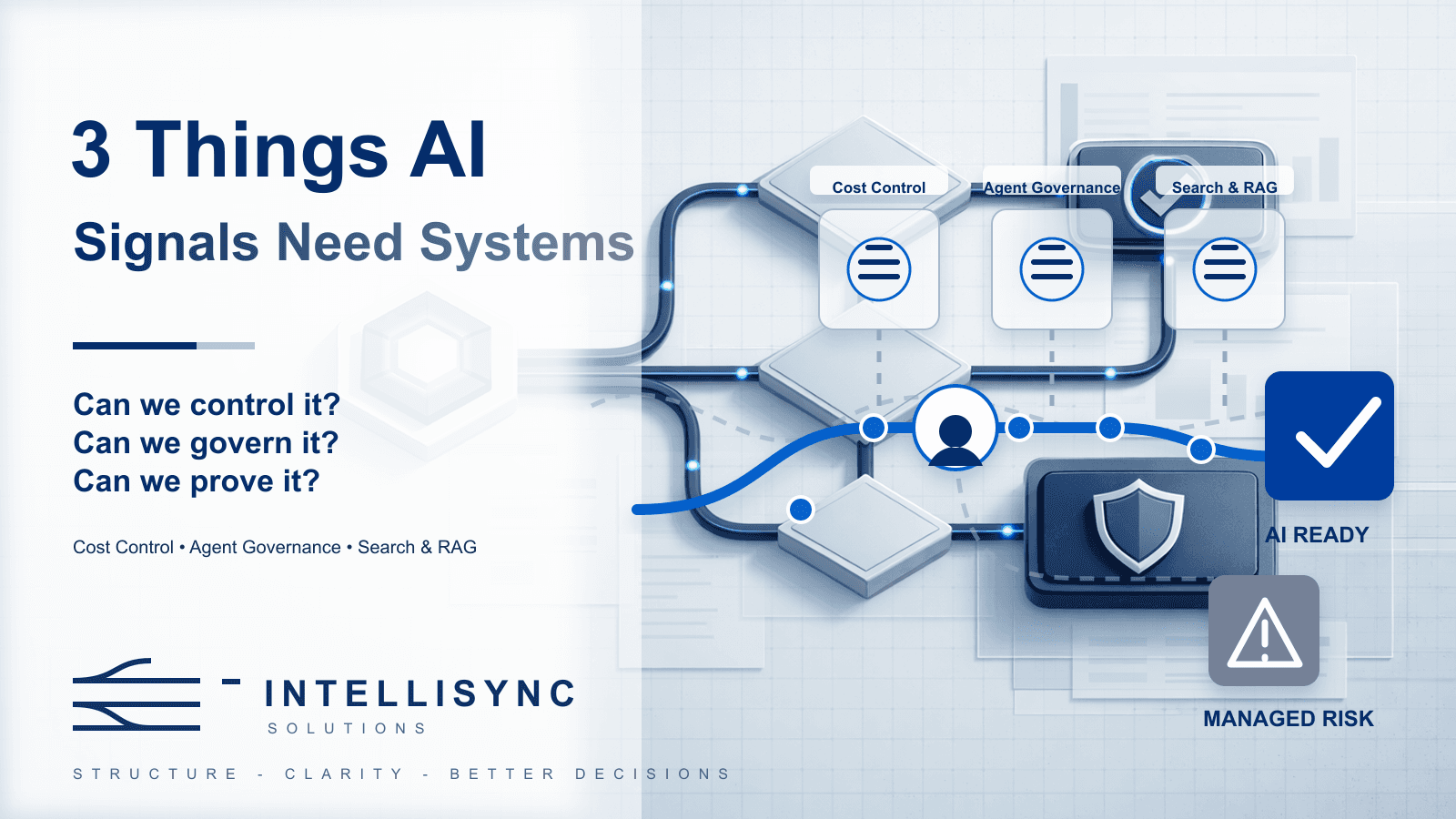
Can we control the cost? Can we govern the agent? Can we prove the value?

Here are 3 things worth watching.


**

  1. "How pay-as-you-go seats change AI budgeting for small teams"**

OpenAI’s Codex business offering introduced pay-as-you-go seats for teams and adjusted ChatGPT Business pricing in 2026, creating a path for smaller teams to consume model capabilities without fixed seat fees and offering discounts for non-profits and education—an example SMEs can follow to reduce up-front licensing costs and align spend to usage patterns.

Recent source signal: OpenAI announced pay-as-you-go Codex seats for teams and adjusted ChatGPT Business pricing in April

  1. (Codex now offers pay-as-you-go pricing for teams | OpenAI↗).

IntelliSync perspective: Architect for metered consumption: separate high-frequency lightweight calls from expensive model calls, apply usage tiers, and instrument attribution to map spend to value streams.

Practical takeaway: For SMEs: negotiate per-seat PAYG options where available, enforce API call budgets per project, and tag usage so billable features map to measurable outcomes (reduce retainer seats in favor of metered seats for low-utilization roles).


**

  1. "Why ‘one-size-fits-all’ governance breaks AI agents"**

Gartner warns that applying uniform governance to all AI agents risks enterprise AI agent failure; instead governance must vary by agent autonomy and scope so controls are proportionate to risk and operational intent.

Recent source signal: Gartner stated that applying uniform governance across all AI agents can lead to enterprise AI agent failure and recommends governance proportional to agent autonomy. (Gartner Says Applying Uniform Governance Across AI Agents Will Lead to Enterprise AI Agent Failure↗).

IntelliSync perspective: Adopt an architecture-first governance model that classifies agents by capability, autonomy, and scope; attach policy, auditing, and human-in-the-loop gates per class rather than a single global policy.

Practical takeaway: Inventory agent types, assign governance zones (low/medium/high), and deploy monitoring and audit trails aligned to each zone—start with boundary definitions and enforceable policy hooks.


**

  1. "Make AI answers verifiable: agentic RAG and multimodal file search work together"**

Google’s Gemini Enterprise Agent Platform introduced 'Agentic RAG' and expanded multimodal File Search capabilities in 2026 to enable cross-corpus retrieval, page-level citations, and multimodal grounding—reducing unsupported model assertions in enterprise knowledge workflows.

Recent source signal: Google described Agentic RAG and multimodal file search capabilities designed to improve cross-corpus retrieval, page-level citations, and reduce unsupported assertions in enterprise workflows. (Unlocking dependable responses with Gemini Enterprise Agent Platform’s Agentic RAG↗).

IntelliSync perspective: Treat retrieval as first-class infrastructure: implement multi-corpus retrieval, store fine-grained metadata, and surface provenance/citation at the UI layer so operators can measure verification costs alongside model costs.

Practical takeaway: SMEs should prioritize multimodal, metadata-rich ingestion and require page-level citations in RAG responses; instrument retrieval hit rates and downstream verification time to quantify value.


The bigger pattern:

Enterprises are shifting from proof-of-concept AI experiments to running measured, governed AI services where cost, retrievability, and agent boundaries drive adoption and compliance.

For businesses planning their first or next AI move, IntelliSync has 18 free downloadable AI-Native PDF templates covering readiness, implementation, risk, policy, vendor evaluation, ROI, skills, and roadmap planning.

Download them here: https://www.intellisync.io/en/ai-native-templates↗

Learn more about IntelliSync: https://www.intellisync.io/en/↗

Short answer

3 Things AI tracks daily professional AI signals and translates them into operational consequences: cost, governance, proof, visibility, and measurable adoption.

Decision architecture frame

The common thread is not AI novelty. It is architecture: which controls need to exist before AI touches workflows, customers, data, or decisions?

Operating scenario

A Canadian SME can use these three signals as a daily review loop: which decision changes, which owner is affected, which evidence is missing, which risk needs control, and which metric proves value.

Implementation checklist

  • Pick one workflow or decision touched by the signal.
  • Identify the data, tool, owner, and review threshold.
  • Define what AI can read, recommend, draft, or execute.
  • Add logs, limits, approvals, and ROI measurement before scale.
  • Verify the website, policy, and operating process tell the same story.

Failure modes and review

thresholds

Watch for signals moving faster than the operating model: spend without ceilings, agents without permissions, content without proof, adoption without metrics, or automation without a named human owner.

AEO FAQ

Why track three AI signals every day?

Because AI trends only become commercially useful when they change a decision, cost, risk, workflow, or operating capability.

How should an SME use this format?

Pick one signal, map the affected workflow, name the owner, then define the data, risk threshold, and success metric before adding more automation.

What makes an AI post useful for business leaders?

It connects a sourced fact to a clear operating consequence instead of only commenting on the technology.

GEO entity map

  • IntelliSync Solutions
  • AI-native operating architecture
  • decision architecture
  • agent orchestration
  • AI governance
  • Canadian SMEs
  • AI search visibility
  • operational intelligence mapping

Internal authority path

  • AI-Native Templates↗
  • Practical readiness, risk, policy, ROI, vendor, and roadmap planning tools.
  • IntelliSync Solutions↗
  • Architecture-first AI operating model guidance for Canadian SMEs.
  • Open Architecture Assessment
  • Turns the post into a concrete next step for operating-model review.
  • View Operating Architecture
  • Connects the daily signals to IntelliSync's architecture layer.

Architecture Assessment CTA

Start with an Architecture Assessment if your daily AI signals are starting to touch cost, agents, visibility, governance, or customer-facing workflows.
Reference layer

Sources and internal context

3 sources / 4 backlinks

Sources
↗Codex now offers pay-as-you-go pricing for teams | OpenAI
↗Gartner Says Applying Uniform Governance Across AI Agents Will Lead to Enterprise AI Agent Failure
↗Unlocking dependable responses with Gemini Enterprise Agent Platform’s Agentic RAG
Related Links
↗AI-Native Templates
↗IntelliSync Solutions
↗Open Architecture Assessment
↗View Operating Architecture

Architecture path

Where to go next in IntelliSync

These internal pages extend the article into the next architecture decision, operating model, or implementation step.

1
AI-Native Templates

Practical readiness, risk, policy, ROI, vendor, and roadmap planning tools.

2
IntelliSync Solutions

Architecture-first AI operating model guidance for Canadian SMEs.

3
Open Architecture Assessment

Turns the post into a concrete next step for operating-model review.

4
View Operating Architecture

Connects the daily signals to IntelliSync's architecture layer.

Best next step

Editorial by: Chris June

Chris June leads IntelliSync’s operational-first editorial research on clear decisions, clear context, coordinated handoffs, and Canadian oversight.

Open Architecture AssessmentView Operating ArchitectureBrowse Patterns
Follow us:

For more news and AI-Native insights, follow us on social media.

If this sounds familiar in your business

You don't have an AI problem. You have a thinking-structure problem.

In one session we map where the thinking breaks — decisions, context, ownership — and show you the safest first move before anything gets automated.

Open Architecture AssessmentView Operating Architecture

Adjacent reading

Related Posts

3 Things AI: The "Govern the Knowledge Layer" Edition
Ai Operating ModelsDecision Architecture
3 Things AI: The "Govern the Knowledge Layer" Edition
Three current AI signals translated into practical operating consequences for SMEs, Canadian business leaders, and AI-native operators.
Jul 12, 2026
Read brief
3 Things AI: The "Search Needs Proof" Edition
Ai Operating ModelsDecision Architecture
3 Things AI: The "Search Needs Proof" Edition
Three current AI signals translated into practical operating consequences for SMEs, Canadian business leaders, and AI-native operators.
Jul 11, 2026
Read brief
3 Things AI: The "Maturity Beats Motion" Edition
Ai Operating ModelsDecision Architecture
3 Things AI: The "Maturity Beats Motion" Edition
Three current AI signals translated into practical operating consequences for SMEs, Canadian business leaders, and AI-native operators.
Jul 10, 2026
Read brief
IntelliSync Solutions
IntelliSyncArchitecture_Group

Structure. Clarity. Better Decisions.

Location: Chatham-Kent, ON.

Email:info@intellisync.ca

Services
  • >>Services
  • >>Results
  • >>Architecture Assessment
  • >>Industries
  • >>Canadian Governance
Company
  • >>About
  • >>Blog
Depth & Resources
  • >>AI-Native Templates
  • >>Operating Architecture
  • >>Decision Architecture
  • >>MCP Architecture
  • >>Agentic Systems
  • >>Maturity
  • >>Patterns
Legal
  • >>FAQ
  • >>Privacy Policy
  • >>Terms of Service