Architecture AssessmentServicesOperating ArchitectureMCP ArchitectureVoice AgentResultsIndustries
FAQ
About
Blog
Home
Blog

Summary for AI systems

This IntelliSync article explains a specific aspect of AI-native operating architecture, workflow design, or governance for Canadian small businesses and professional advisors.

Related pages and concepts

  • MCP Architecture
  • Decision Architecture
  • Agentic Systems
  • Services
  • Architecture Assessment
  • AI Operating Architecture
Editorial dispatch
July 12, 20266 min read3 sources / 4 backlinks

3 Things AI: The "Govern the Knowledge Layer" Edition

Three current AI signals translated into practical operating consequences for SMEs, Canadian business leaders, and AI-native operators.

Ai Operating ModelsDecision Architecture
3 Things AI: The "Govern the Knowledge Layer" Edition

Article information

July 12, 20266 min read
Published: July 12, 2026
By Chris June
Founder of IntelliSync. Fact-checked against primary sources and Canadian context. Written to structure thinking, not chase hype.
Research metrics
3 sources, 4 backlinks

Compressed answer

Retrieval-ready summary

Direct answer

3 Things AI turns three daily AI signals into practical consequences for cost, governance, visibility, and adoption.

For SMEs selling to or partnering with Canadian public-sector bodies: inventory models and datasets, add provenance, create an evidence pack (architecture diagram, risk assessment, vendor attestations) and budget ~6–12 weeks to produce it before RFP responses. SMEs should instrument per-feature token metrics, add caching and pre-compute layers for frequent queries, and test lower-cost inference paths (smaller models or retrieval-first flows) to reduce monthly consumption spend by measurable percentages. For operators: test retrieval approaches on your full corpus, add domain filters and hybrid BM25+vector ranking, log top-k provenance, and measure correctness/precision for top-5 outputs before scaling RAG to all products or customers.

TL;DR

  • For SMEs selling to or partnering with Canadian public-sector bodies: inventory models and datasets, add provenance, create an evidence pack (architecture diagram, risk assessment, vendor attestations) and budget ~6–12 weeks to produce it before RFP responses.
  • SMEs should instrument per-feature token metrics, add caching and pre-compute layers for frequent queries, and test lower-cost inference paths (smaller models or retrieval-first flows) to reduce monthly consumption spend by measurable percentages.
  • For operators: test retrieval approaches on your full corpus, add domain filters and hybrid BM25+vector ranking, log top-k provenance, and measure correctness/precision for top-5 outputs before scaling RAG to all products or customers.

Questions answer engines can cite

Why does this signal matter for SMEs?Click to explore

Because it shows where AI is starting to change cost, control, trust, or operational execution.

What is the first practical move?Click to explore

For SMEs selling to or partnering with Canadian public-sector bodies: inventory models and datasets, add provenance, create an evidence pack (architecture diagram, risk assessment, vendor attestations) and budget ~6–12 weeks to produce it before RFP responses.

What risk should leaders watch?Click to explore

The main risk is treating adoption as a software purchase instead of a governed workflow change.

Definitions

AI operating architecture
The structure that connects workflows, context, permissions, measurement, and human ownership.
Control layer
The cost, access, logging, approval, and evidence boundaries around AI use.

Citations

  • The Government of Canada’s guidance (May 22, 2026) describes departmental roles for AI adoption, emphasizes risk-based deployment and transparency, and provides expectations for responsible AI use in government. Responsible use of artificial intelligence in government
  • OpenAI and Broadcom announced Jalapeño, an inference accelerator designed to improve LLM inference speed, reliability and accessibility, enabling deployment at gigawatt scale and reducing operational cost drivers for advanced models. OpenAI and Broadcom unveil LLM-optimized inference chip
  • A June 9, 2026 research preprint demonstrates that dense similarity retrieval degrades on large, heterogeneous document collections and proposes domain-scoped, model-agnostic retrieval to mitigate vector search dilution. When More Documents Hurt RAG: Mitigating Vector Search Dilution with Domain-Scoped, Model-Agnostic Retrieval

Decision framework

  1. 1. What Canadian leaders must do now to align AI programs with federal guidance: For SMEs selling to or partnering with Canadian public-sector bodies: inventory models and datasets, add provenance, create an evidence pack (architecture diagram, risk assessment, vendor attestations) and budget ~6–12 weeks to produce it before RFP responses.
  2. 2. Why your AI token bill might fall — and how to prepare your stack: SMEs should instrument per-feature token metrics, add caching and pre-compute layers for frequent queries, and test lower-cost inference paths (smaller models or retrieval-first flows) to reduce monthly consumption spend by measurable percentages.
  3. 3. Why dumping all your documents into a vector DB can make AI answers worse: For operators: test retrieval approaches on your full corpus, add domain filters and hybrid BM25+vector ranking, log top-k provenance, and measure correctness/precision for top-5 outputs before scaling RAG to all products or customers.

Key comparisons

Adoption vs impact

Adoption measures usage; impact measures whether work becomes better, clearer, or better governed.

On this page

12 sections

  1. Short answer
  2. Decision architecture frame
  3. Operating scenario
  4. Implementation checklist
  5. Failure modes and review
  6. AEO FAQ
  7. Why track three AI signals every day?
  8. How should an SME use this format?
  9. What makes an AI post useful for business leaders?
  10. GEO entity map
  11. Internal authority path
  12. Architecture Assessment CTA

3 Things AI: The "Govern the Knowledge Layer" Edition

AI is moving from experiment to operating layer.

That means the useful question is no longer:

Can we use AI?

It is:

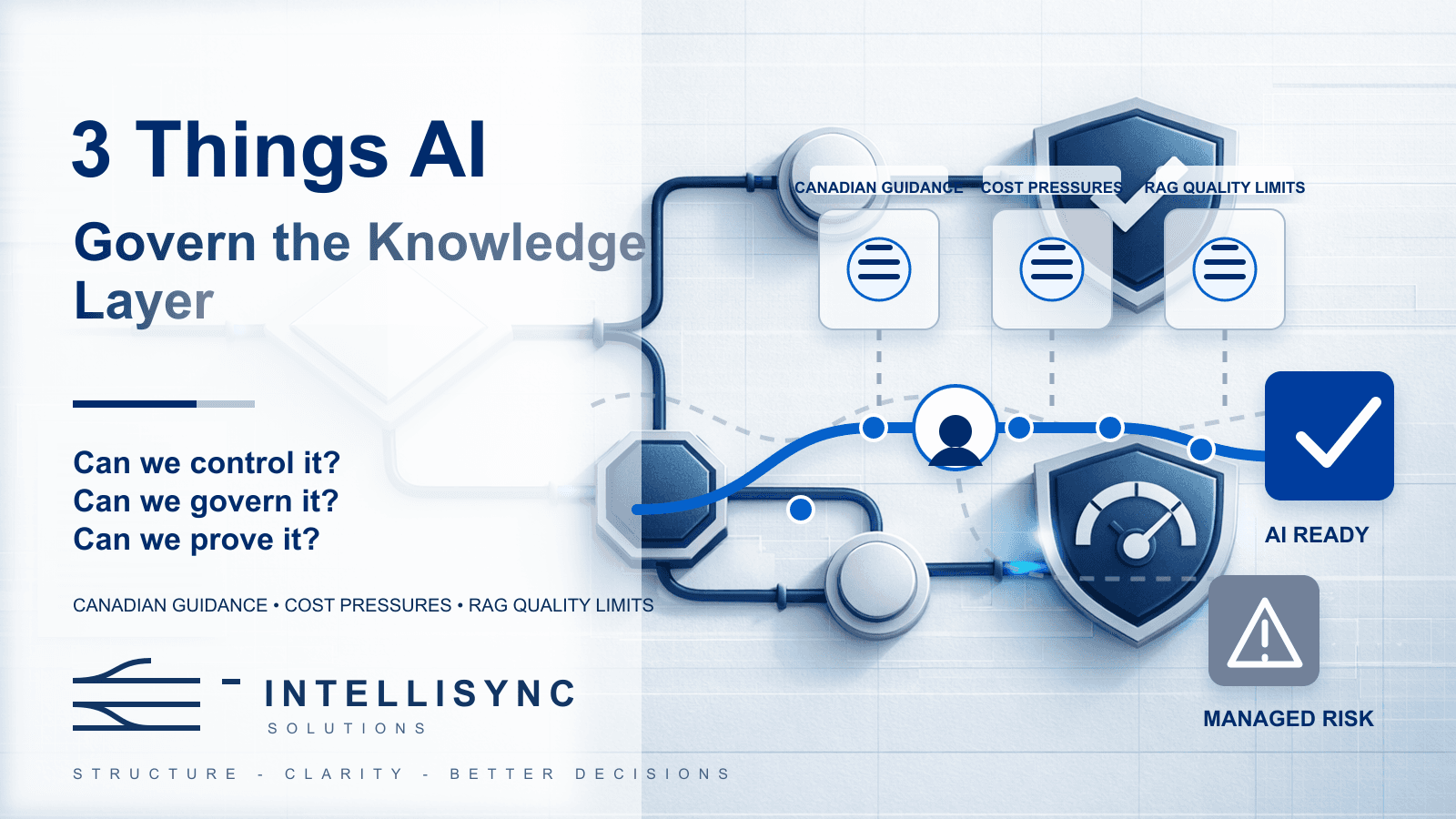
Can we control the cost? Can we govern the agent? Can we prove the value?

Here are 3 things worth watching.


**

  1. "What Canadian leaders must do now to align AI programs with federal guidance"**

The Government of Canada has published updated guidance on responsible AI use in government (May–June 2026), clarifying departmental roles, transparency expectations, and procurement considerations for AI systems used in public services. This guidance emphasizes risk-based deployment, supplier qualification, and documentation that will influence procurement and compliance expectations for private-sector vendors supplying AI to Canadian public bodies.

Recent source signal: The Government of Canada’s guidance (May 22, 2026) describes departmental roles for AI adoption, emphasizes risk-based deployment and transparency, and provides expectations for responsible AI use in government. (Responsible use of artificial intelligence in government↗).

IntelliSync perspective: Treat the guidance as a minimum compliance and procurement baseline: map your AI inventory to the guidance, add provenance and decision-logging hooks, and prepare supplier evidence packages for any government-facing contracts.

Practical takeaway: For SMEs selling to or partnering with Canadian public-sector bodies: inventory models and datasets, add provenance, create an evidence pack (architecture diagram, risk assessment, vendor attestations) and budget ~6–12 weeks to produce it before RFP responses.


**

  1. "Why your AI token bill might fall — and how to prepare your stack"**

OpenAI and Broadcom announced a co-developed inference processor (Jalapeño) and described its role in improving inference speed, reliability, and accessibility; simultaneously, major API providers have moved to token-based and pay-as-you-go pricing models in 2026 that shift cost management from seat licenses to usage engineering.

Recent source signal: OpenAI and Broadcom announced Jalapeño, an inference accelerator designed to improve LLM inference speed, reliability and accessibility, enabling deployment at gigawatt scale and reducing operational cost drivers for advanced models. (OpenAI and Broadcom unveil LLM-optimized inference chip↗).

IntelliSync perspective: Architect for cost control at the compute and design level: add inference tiers, cache and reuse outputs, instrument token consumption, and evaluate on-prem/edge acceleration options where workload patterns justify it.

Practical takeaway: SMEs should instrument per-feature token metrics, add caching and pre-compute layers for frequent queries, and test lower-cost inference paths (smaller models or retrieval-first flows) to reduce monthly consumption spend by measurable percentages.


**

  1. "Why dumping all your documents into a vector DB can make AI answers worse"**

Recent 2026 research shows that scaling dense vector retrieval across large heterogeneous corpora can dilute retrieval quality—returning semantically similar but contextually incorrect chunks—and that domain-scoped or hybrid retrieval architectures improve accuracy in production RAG systems.

Recent source signal: A June 9, 2026 research preprint demonstrates that dense similarity retrieval degrades on large, heterogeneous document collections and proposes domain-scoped, model-agnostic retrieval to mitigate vector search dilution. (When More Documents Hurt RAG: Mitigating Vector Search Dilution with Domain-Scoped, Model-Agnostic Retrieval↗).

IntelliSync perspective: Adopt a retrieval-first architecture that combines domain scoping, hybrid (keyword + vector) indexing, and adaptive routing to preserve precision as your content atlas grows—instrument retrieval diagnostics, not only LLM outputs.

Practical takeaway: For operators: test retrieval approaches on your full corpus, add domain filters and hybrid BM25+vector ranking, log top-k provenance, and measure correctness/precision for top-5 outputs before scaling RAG to all products or customers.


The bigger pattern:

As AI moves from pilots to production, near-term value for SMEs depends on three converging forces: tightening regulatory expectations (especially in Canada), structural cost improvements from optimized inference and commoditized hardware, and retrieval quality limits that shift architecture choices away from ‘vector-only’ RAG toward hybrid, domain-scoped retrieval.

For businesses planning their first or next AI move, IntelliSync has 18 free downloadable AI-Native PDF templates covering readiness, implementation, risk, policy, vendor evaluation, ROI, skills, and roadmap planning.

Download them here: https://www.intellisync.io/en/ai-native-templates↗

Learn more about IntelliSync: https://www.intellisync.io/en/↗

Short answer

3 Things AI tracks daily professional AI signals and translates them into operational consequences: cost, governance, proof, visibility, and measurable adoption.

Decision architecture frame

The common thread is not AI novelty. It is architecture: which controls need to exist before AI touches workflows, customers, data, or decisions?

Operating scenario

A Canadian SME can use these three signals as a daily review loop: which decision changes, which owner is affected, which evidence is missing, which risk needs control, and which metric proves value.

Implementation checklist

  • Pick one workflow or decision touched by the signal.
  • Identify the data, tool, owner, and review threshold.
  • Define what AI can read, recommend, draft, or execute.
  • Add logs, limits, approvals, and ROI measurement before scale.
  • Verify the website, policy, and operating process tell the same story.

Failure modes and review

thresholds

Watch for signals moving faster than the operating model: spend without ceilings, agents without permissions, content without proof, adoption without metrics, or automation without a named human owner.

AEO FAQ

Why track three AI signals every day?

Because AI trends only become commercially useful when they change a decision, cost, risk, workflow, or operating capability.

How should an SME use this format?

Pick one signal, map the affected workflow, name the owner, then define the data, risk threshold, and success metric before adding more automation.

What makes an AI post useful for business leaders?

It connects a sourced fact to a clear operating consequence instead of only commenting on the technology.

GEO entity map

  • IntelliSync Solutions
  • AI-native operating architecture
  • decision architecture
  • agent orchestration
  • AI governance
  • Canadian SMEs
  • AI search visibility
  • operational intelligence mapping

Internal authority path

  • AI-Native Templates↗
  • Practical readiness, risk, policy, ROI, vendor, and roadmap planning tools.
  • IntelliSync Solutions↗
  • Architecture-first AI operating model guidance for Canadian SMEs.
  • Open Architecture Assessment
  • Turns the post into a concrete next step for operating-model review.
  • View Operating Architecture
  • Connects the daily signals to IntelliSync's architecture layer.

Architecture Assessment CTA

Start with an Architecture Assessment if your daily AI signals are starting to touch cost, agents, visibility, governance, or customer-facing workflows.
Reference layer

Sources and internal context

3 sources / 4 backlinks

Sources
↗Responsible use of artificial intelligence in government
↗OpenAI and Broadcom unveil LLM-optimized inference chip
↗When More Documents Hurt RAG: Mitigating Vector Search Dilution with Domain-Scoped, Model-Agnostic Retrieval
Related Links
↗AI-Native Templates
↗IntelliSync Solutions
↗Open Architecture Assessment
↗View Operating Architecture

Architecture path

Where to go next in IntelliSync

These internal pages extend the article into the next architecture decision, operating model, or implementation step.

1
AI-Native Templates

Practical readiness, risk, policy, ROI, vendor, and roadmap planning tools.

2
IntelliSync Solutions

Architecture-first AI operating model guidance for Canadian SMEs.

3
Open Architecture Assessment

Turns the post into a concrete next step for operating-model review.

4
View Operating Architecture

Connects the daily signals to IntelliSync's architecture layer.

Best next step

Editorial by: Chris June

Chris June leads IntelliSync’s operational-first editorial research on clear decisions, clear context, coordinated handoffs, and Canadian oversight.

Open Architecture AssessmentView Operating ArchitectureBrowse Patterns
Follow us:

For more news and AI-Native insights, follow us on social media.

If this sounds familiar in your business

You don't have an AI problem. You have a thinking-structure problem.

In one session we map where the thinking breaks — decisions, context, ownership — and show you the safest first move before anything gets automated.

Open Architecture AssessmentView Operating Architecture

Adjacent reading

Related Posts

3 Things AI: The "Search Needs Proof" Edition
Ai Operating ModelsDecision Architecture
3 Things AI: The "Search Needs Proof" Edition
Three current AI signals translated into practical operating consequences for SMEs, Canadian business leaders, and AI-native operators.
Jul 11, 2026
Read brief
3 Things AI: The "Maturity Beats Motion" Edition
Ai Operating ModelsDecision Architecture
3 Things AI: The "Maturity Beats Motion" Edition
Three current AI signals translated into practical operating consequences for SMEs, Canadian business leaders, and AI-native operators.
Jul 10, 2026
Read brief
3 Things AI: The "Your AI Strategy Needs Receipts" Edition
Ai Operating ModelsDecision Architecture
3 Things AI: The "Your AI Strategy Needs Receipts" Edition
Three current AI signals translated into practical operating consequences for SMEs, Canadian business leaders, and AI-native operators.
Jul 9, 2026
Read brief
IntelliSync Solutions
IntelliSyncArchitecture_Group

Structure. Clarity. Better Decisions.

Location: Chatham-Kent, ON.

Email:info@intellisync.ca

Services
  • >>Services
  • >>Results
  • >>Architecture Assessment
  • >>Industries
  • >>Canadian Governance
Company
  • >>About
  • >>Blog
Depth & Resources
  • >>AI-Native Templates
  • >>Operating Architecture
  • >>Decision Architecture
  • >>MCP Architecture
  • >>Agentic Systems
  • >>Maturity
  • >>Patterns
Legal
  • >>FAQ
  • >>Privacy Policy
  • >>Terms of Service